Midarm vs Longarm Quilting Machines: Grace Little Rebel vs Grace 19X Elite
Choose a midarm if you quilt throws and twins or have limited space: the Grace Little Rebel offers a 13 x 8.5 in throat, 1,600 SPM and stitch regulation for about $2,799. Choose a longarm for frequent queen and king quilts: the Grace Qnique 19X Elite offers a 19 in throat and touchscreen for about $10,499.
The verdict
A midarm is the better buy for most home quilters who finish throws and twin quilts, and a longarm is worth its much higher price only if you finish many large quilts or quilt for others. The Grace Little Rebel costs about a quarter of the Grace 19X Elite + Cutie package, so the longarm has to save you a lot of time to earn the difference.
The useful truth: "midarm" and "longarm" have no official definitions. Manufacturers use the words loosely, and a 15 or 16 in machine may be sold as either. Ignore the label and compare throat space, which is the distance from the needle to the back of the machine, because that decides how much quilt you can stitch before you stop to reposition.
Midarm vs Longarm: side by side
| Feature | Midarm | Longarm |
|---|---|---|
| Representative model | Grace Little Rebel | Grace 19X Elite + Cutie |
| Price | About $2,799 | About $10,499 |
| Throat space | 13 x 8.5 in | 19 in |
| Max speed | 1,600 SPM | Not listed in the specs we verified |
| Stitch regulation | Built in | Check current listing for modes |
| Screen | Not listed in the specs we verified | 7 in full-color touchscreen |
| Setup | Table, or on a frame | Tabletop frame, included |
| Also sews seams | Yes, sewing and quilting setups | No, quilting only |
| Comfortable quilt sizes | Wall, baby, throw, twin | Throw through king |
What is the difference between a midarm and a longarm quilting machine?
Throat space, and what that space lets you do. A domestic sewing machine usually has 6 to 10 in. Machines with roughly 9 to 16 in are commonly called midarms, and machines from about 15 in up are commonly sold as longarms, with overlap in the middle. More throat means more quilt fits in the harp at once, so you quilt wider bands of a design before advancing or repositioning.
| Class | Typical throat | Example | Price | Room you should plan for |
|---|---|---|---|---|
| Domestic | 6 to 10 in | Juki TL-2010Q | About $1,199 | A sewing table or cabinet |
| Small midarm | About 9 in | Juki TL-15 (9 x 6.75 in) | About $1,399 | A large table |
| Midarm | About 13 in | Grace Little Rebel (13 x 8.5 in) | About $2,799 | A large table, or a frame if you add one |
| Entry longarm | 15 to 16 in | Handi Quilter Moxie + Loft (15 in), Grace 16X Elite + Cutie (16 in) | About $5,495 to $5,499 | A long table or 8 ft frame; roughly 10 ft of clear wall for a floor frame |
| Longarm | 18 to 20 in | Handi Quilter Moxie XL + Loft (18 in), Grace 19X Elite + Cutie (19 in) | About $8,495 to $10,499 | A dedicated room for floor frames; tabletop frames need a long clear table |
Room figures are general planning ranges, not manufacturer dimensions. Check the published footprint of the exact package and frame before ordering.
Is a midarm quilting machine worth it?
For many quilters it is the most sensible upgrade. The Grace Little Rebel moves you from a 9 in domestic harp to 13 x 8.5 in, adds stitch regulation that keeps stitch length even as your hands speed up or slow down, and still sews regular seams. You can use it at a table now and put it on a frame later. Owners often describe it as the machine that finally made quilting their own tops practical.
The honest limit: a midarm on a table still means basting and wrestling the full weight of large quilts. If you mostly make queen and king quilts, you may outgrow it. Run the numbers through the longarm cost calculator: if you currently pay for longarm services several times a year, the longarm math improves quickly.
Is a 19 inch longarm worth the extra money?
Only for a specific quilter: one who finishes many large quilts, wants dense custom designs with fewer advances, or plans to quilt for paying customers. The Grace 19X Elite + Cutie adds a 7 in touchscreen with on-screen guides. It comes on a tabletop frame that fits on a table and stores away, so check the frame's published maximum quilt size against the quilts you make.
For everyone else, there is a strong middle step: the Grace 16X Elite + Cutie has a 16 in throat and the same 7 in touchscreen style on the same frame for about $5,499, roughly half the price. Size your quilts first with the quilt size calculator.
Choose Midarm if
- You quilt throws, baby quilts, wall hangings and twins.
- You want one machine that also sews seams.
- Your budget is under $3,000.
- You want to start at a table and maybe add a frame later.
Choose Longarm if
- You finish many queen and king quilts a year.
- You quilt for customers or a guild charity program.
- You want a touchscreen with on-screen guides.
- You want the fewest advances per quilt.
Our picks by throat space

Juki TL-15 Mid-Arm Quilting and Piecing Machine
$1,399.00The low-cost small midarm: 9 x 6.75 in throat, 1,500 SPM and a knee lifter.
Check price
Grace Little Rebel Sewing and Quilting Machine
$2,799.00A 13 x 8.5 in midarm with stitch regulation that works at a table or on a frame.
Check price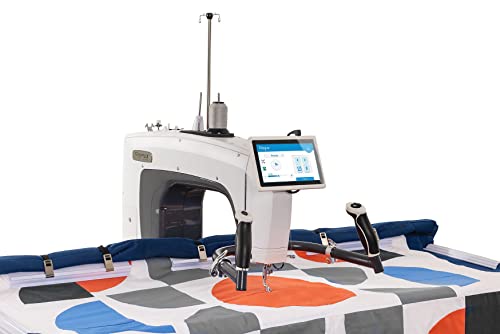
Grace Qnique 16X Elite Longarm Quilting Machine with Cutie Tabletop Frame
$5,499.00The middle step: 16 in throat and 7 in touchscreen for about $5,499.
Check price
Handi Quilter Moxie 15 Longarm with 8 ft HQ Loft Frame
$5,495.00A 15 in longarm with three stitch regulation modes on an 8 ft floor frame.
Check price
Grace Qnique 19X Elite Longarm with Cutie Tabletop Frame
$10,499.00A 19 in throat with a full-color touchscreen for high-volume quilters.
Check pricePrices change often, so confirm on Amazon. As an Amazon Associate we earn from qualifying purchases.
This comparison is drawn from published specifications, owner manuals and the consensus of verified owner reviews, not side-by-side testing.
Frequently asked questions
How much throat space do I need for a queen size quilt?
You can quilt a queen on almost any machine with enough patience, but comfort improves sharply with throat space. On a table, 13 in or more makes queen quilts manageable. On a frame, 15 to 19 in lets you stitch wide bands before advancing. Our throat space calculator estimates how much room your rolled quilt needs.
Can a midarm go on a quilting frame?
Some can. The Grace Little Rebel is described as usable at a table or on a frame, which gives you a path to frame quilting without buying a new machine. Check frame compatibility with the manufacturer, because carriage mounts differ. A frame adds cost and floor space, so budget for both before planning the upgrade.
Is the Juki TL-15 a midarm?
Yes, the Juki TL-15 is a table-top midarm with a 9 x 6.75 in throat, 1,500 SPM, an automatic thread trimmer and a knee lifter, at about $1,399. It is a modest step up in room from a domestic machine like the Juki TL-2010Q, and a much smaller investment than the 13 in class.
What is stitch regulation and does a midarm need it?
Stitch regulation senses how fast the fabric or machine moves and adjusts needle speed so every stitch stays the same length. It is the feature that most helps new free-motion quilters. A midarm without it still works, but you must coordinate hand speed and machine speed yourself. Many quilters consider regulation worth paying for on any machine above 12 in.
Do longarms hold their resale value?
Well-maintained longarms from established brands generally sell on the used market, often through dealers and quilting groups, but at a meaningful discount from new. Resale depends on age, service history and whether the frame is included. Treat resale as a cushion, not a plan, and buy the size you expect to use for years.
How we research: we compare manufacturer specifications, owner manuals, published standards and recurring themes in verified owner reviews. We do not test products in person, and this is researched guidance, not professional advice. Follow your machine manual and pattern, and take care with rotary cutters, hot irons and needles. As an Amazon Associate we earn from qualifying purchases.