20 Inch Quilt Block: Cut Sizes, Grids and How Many Blocks per Quilt
A 20 inch finished quilt block is cut 20 1/2 x 20 1/2 inches, because every edge carries a 1/4 inch seam allowance. It divides cleanly into 3 ruler-friendly grids, including a four patch of 10 inch units cut at 10 1/2 inches. A queen quilt needs 25 blocks with no sashing.
A 20 inch finished quilt block is cut 20 1/2 x 20 1/2 inches square, because each of its four edges carries a 1/4 inch seam allowance. Quilt block sizes are always given as the finished size, the part you still see once the block is sewn into the quilt, so a 20 inch block is pieced and trimmed to 20 1/2 inches and then loses 1/4 inch on every side to the seams that join it to its neighbors.
What size do you cut the pieces for a 20 inch block?
Most traditional blocks are built on a grid. Divide 20 inches by the number of grid units to get each unit's finished size, then add 1/2 inch for squares or 7/8 inch for two-at-a-time half square triangles. Grids marked "awkward" land between the eighth-inch marks on the ruler, and the quilt block size calculator handles any grid this chart does not list.
| Grid | Unit finishes at | Cut squares | Cut HST squares | Ruler friendly |
|---|---|---|---|---|
| Four patch (2 x 2) | 10 in | 10 1/2 in | 10 7/8 in | Yes |
| Nine patch (3 x 3) | 6.667 in | awkward | awkward | No |
| 4 x 4 grid | 5 in | 5 1/2 in | 5 7/8 in | Yes |
| 5 x 5 grid | 4 in | 4 1/2 in | 4 7/8 in | Yes |
| 6 x 6 grid | 3.333 in | awkward | awkward | No |
The table above shows every grid a 20 inch block divides into: 3 of the five are ruler friendly, the four patch grid gives 10 inch units cut at 10 1/2 inches, and a nine patch does not, because 20 inches will not divide by three onto the ruler.
Those units are where this block meets the other cutting charts. Its 10 inch four patch unit is outside the charted HST sizes, so take the cut size from the HST column above. A sawtooth star at this size would need geese finishing at 5 inches, which is not one of the charted flying geese sizes.
How many 20 inch blocks do you need for each quilt size?
Blocks across and down are rounded to the nearest whole block, so the finished top lands close to the typical quilt size. Sashing is the strip of fabric between blocks, and with 2 inch finished sashing you need fewer blocks for the same quilt; the sashing and borders calculator sizes those strips. To check a count against your own layout, use the blocks needed calculator.
| Quilt | Typical size | No sashing | Top size | With 2 in sashing | Top size |
|---|---|---|---|---|---|
| Baby | 40 x 40 | 2 x 2 = 4 | 40 x 40 | 2 x 2 = 4 | 42 x 42 |
| Crib | 36 x 52 | 2 x 3 = 6 | 40 x 60 | 2 x 2 = 4 | 42 x 42 |
| Lap | 45 x 60 | 2 x 3 = 6 | 40 x 60 | 2 x 3 = 6 | 42 x 64 |
| Throw | 50 x 65 | 3 x 3 = 9 | 60 x 60 | 2 x 3 = 6 | 42 x 64 |
| Twin | 68 x 90 | 3 x 5 = 15 | 60 x 100 | 3 x 4 = 12 | 64 x 86 |
| Twin XL | 68 x 95 | 3 x 5 = 15 | 60 x 100 | 3 x 4 = 12 | 64 x 86 |
| Full / Double | 83 x 90 | 4 x 5 = 20 | 80 x 100 | 4 x 4 = 16 | 86 x 86 |
| Queen | 90 x 95 | 5 x 5 = 25 | 100 x 100 | 4 x 4 = 16 | 86 x 86 |
| King | 106 x 95 | 5 x 5 = 25 | 100 x 100 | 5 x 4 = 20 | 108 x 86 |
| California King | 102 x 99 | 5 x 5 = 25 | 100 x 100 | 5 x 5 = 25 | 108 x 108 |
The table above turns a 20 inch block into a block count for 10 standard quilt sizes: a 50 x 65 inch throw takes 9 blocks and a 90 x 95 inch queen takes 25. Once those blocks become a top, the quilt top yardage calculator converts the count into fabric, and a queen still needs queen quilt backing yardage plus enough queen quilt binding to cover its 370 inch perimeter.
Block size drives the workload more than any other choice: a queen takes 25 blocks at 20 inches. A 18 inch block would need 25. A 24 inch block would need 16. A 10 inch block would need 90.
Make a test block first
Sew one block and measure it before cutting fabric for 25. If it comes out 1/8 inch small, your seam allowance is slightly wide, and that error would add up to inches across a quilt. A scant 1/4 inch seam usually fixes it.
Tools for cutting and squaring 20 inch blocks
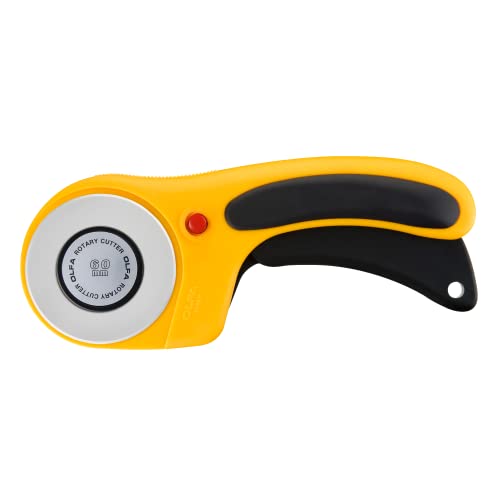
Olfa 60mm Ergonomic Squeeze-Handle Rotary Cutter RTY-3/DX
Under $50Cuts several layers of fabric at once, which speeds up cutting dozens of identical squares.
Check price
Creative Grids 12-1/2 x 24-1/2 Rectangle Quilt Ruler
Under $100Long grippy ruler for cutting strips to the exact width before subcutting squares.
Check price
Olfa 17 x 17 Rotating Cutting Mat RM-17S
Under $250A rotating mat lets you trim all four sides of a block without moving the fabric.
Check pricePrices change often, so confirm on Amazon. As an Amazon Associate we earn from qualifying purchases.
Frequently asked questions
What is the unfinished size of a 20 inch quilt block?
A 20 inch block is the finished size, measured after it is sewn into the quilt. Before that it measures 20 1/2 x 20 1/2 inches, because each edge carries a 1/4 inch seam allowance that disappears into the seams. Trim every block to exactly 20 1/2 inches with a square ruler before joining them, so the rows line up.
How many 20 inch blocks do I need for a queen quilt?
A 90 x 95 inch queen quilt takes 5 blocks across and 5 down, 25 blocks in total, for a finished top of 100 x 100 inches. Add 2 inch sashing between the blocks and the count drops to 16. A border reduces it further, so settle the layout before you piece every block.
What size squares do I cut for a 20 inch nine patch?
A 20 inch block does not divide evenly into thirds on a standard ruler, because each square would finish at 6.667 inches. Use a four patch (2 x 2) instead, where the units finish at 10 inches, or change the finished block to a multiple of 3 such as 21 inches.
What size half square triangles go in a 20 inch block?
In a four patch layout each half square triangle finishes at 10 inches, cut from 10 7/8 inch squares with the two-at-a-time method, or 11 inch squares if you would rather trim them down. A nine patch grid does not divide this block cleanly, so four patch or 4 x 4 layouts work better.
How much fabric do I need for 20 inch nine patch blocks?
A 20 inch block does not divide into thirds on the eighth-inch ruler, so a true nine patch is impractical at this size. Piece a four patch of 10 inch units cut at 10 1/2 inches instead, work the yardage for your 9 block throw or 25 block queen, and add about 10 percent for trimming and mistakes.
Is 20 inches a good quilt block size?
Most quilt patterns use blocks between 6 and 12 inches, so 20 inches counts as large and fast: a queen quilt needs only 25 blocks, and big prints get room to show. The trade-off is that intricate piecing repeats fewer times across the quilt. Large blocks also make long, heavy rows, where a machine with generous throat space is easier to work with.
How we research: we compare manufacturer specifications, owner manuals, published standards and recurring themes in verified owner reviews. We do not test products in person, and this is researched guidance, not professional advice. Follow your machine manual and pattern, and take care with rotary cutters, hot irons and needles. As an Amazon Associate we earn from qualifying purchases.