Blanket Yarn Calculator: How Much Yarn for a Knit or Crochet Blanket
A 50 x 60 inch throw in worsted weight takes about 2,080 to 2,880 yards knitted or 2,610 to 3,830 yards crocheted. With 10 percent extra and 200 yard skeins, buy 16 skeins to knit it or 22 to crochet it. A queen takes 6,250 to 8,650 yards knitted.
Pick a blanket size or type your own, choose the yarn weight, and enter the yards on one skein. The calculator estimates yardage for knitting and crochet side by side, adds a cushion, and shows exactly how the estimate was scaled so you can judge it.
Your blanket
Your results
Knitted blanket
Buy 16 skeins (3,169 yd with 10 percent extra)
| Knit | Crochet | |
|---|---|---|
| Yards | 2,080 to 2,880 | 2,610 to 3,830 |
| Skeins to buy | 16 | 22 |
| Grams | 900 to 1,690 g | 1,130 to 2,250 g |
Scaled from the published Throw (50 x 65 in) by area, x 0.92.
A throw is thousands of yards: work smarter
At throw size, winding and knitting time add up. A crank machine knits long plain panels, a swift and winder preps every skein, and a bulk box keeps the dye lot consistent.

addi Express Kingsize Knitting Machine, 46 needles
$157.12A 46 needle knitting machine with a 17.7 inch flat mode and a 13.8 inch circular mode.
Check price
Stanwood Needlecraft 10 oz Metal Ball Winder and Amish Style Swift Bundle
$121.95A 10 oz metal ball winder and Amish style swift for jumbo blanket skeins.
Check price
Lion Brand Pound of Love Yarn, bulk 12 pack
$132.90Twelve skeins of worsted in one box, a bulk buy sized for throws.
Check pricePrices change often, so confirm on Amazon. As an Amazon Associate we earn from qualifying purchases.
Baby and lovey blankets: soft yarn and a comfy hook
Small blankets are quick. Soft, washable yarn and a cushioned hook make them a pleasure to finish.

Caron Simply Soft Yarn, Medium Worsted #4, 3 Pack, Off White
$15.39Three 315 yard balls of soft worsted acrylic with a published crochet gauge on a 5 mm hook.
Check price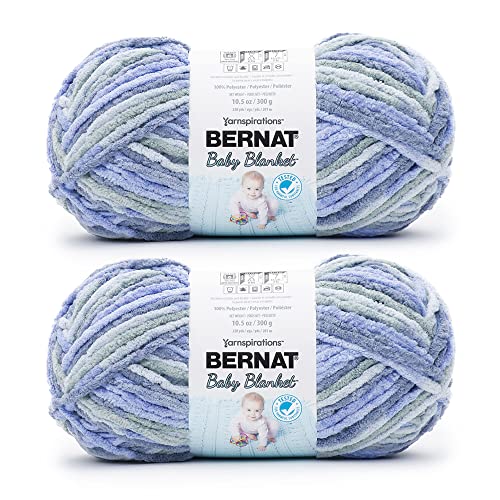
Bernat Baby Blanket Yarn, Super Bulky #6, 2 Pack of 300 g, Lovely Blue
$21.69Two 220 yard balls of super bulky polyester with a crochet gauge on a 6.5 mm K hook.
Check price
Tulip Etimo Rose Crochet Hook Set
$109.99Ten cushion grip hooks from 2 to 6 mm in a case, for long crochet sessions.
Check pricePrices change often, so confirm on Amazon. As an Amazon Associate we earn from qualifying purchases.
Bed size blankets: the full machine kit and a proper chair
Twin to king blankets run to many thousands of yards. Two machines, bulk yarn and a supportive chair make a very long project far more manageable.

addi I Want It All Knitting Machine Pro Set (Kingsize and Express Pro)
$410.00Both the 46 needle Kingsize and 22 needle Express Pro machines with three pattern books and spare needles.
Check price Lion Brand Pound of Love Yarn, bulk 12 pack
$132.90Twelve worsted skeins per box, so a bed blanket is a few boxes from one order.
Check price
Arrow H7013B Adjustable Height Hydraulic Sewing Chair
$399.99A hydraulic chair adjustable from 18 to 22 inches with under seat storage for yarn.
Check pricePrices change often, so confirm on Amazon. As an Amazon Associate we earn from qualifying purchases.
How do you calculate how much yarn a blanket needs?
Published yardage guides give ranges for a handful of standard blanket sizes in each yarn weight. Any other size can be estimated by area, because a blanket is a flat rectangle of the same fabric throughout: twice the area takes about twice the yarn. The calculator uses these steps, shown for the default 50 x 60 inch throw in worsted.
- Find the area. 50 x 60 = 3,000 square inches.
- Pick the nearest published size. The reference data has yardage for a baby blanket, a 50 x 65 inch throw, and twin, full, queen and king sizes. The closest by area is the throw at 50 x 65 = 3,250 square inches.
- Scale by the area ratio. 3,000 / 3,250 = 0.92. The published knit range is multiplied by that ratio and rounded to the nearest 10 yards: 2,080 to 2,880 yards knitted and 2,610 to 3,830 yards crocheted.
- Add 10 percent and convert to skeins. 2,880 x 1.1 = 3,169 yards, divided by 200 yards per skein and rounded up = 16 skeins.
Using the nearest size keeps the scaling small, which keeps the estimate close to the published figures. One caution about the source data: the twin, full, queen and king rows are themselves the throw range scaled by area, and the baby blanket range is matched here to the chart's 42 x 52 inch crib size. Treat every figure as a planning estimate, and if your pattern lists yardage, the pattern wins.
How much yarn for every blanket size in worsted weight?
Medium weight yarn, sold as worsted, aran or afghan yarn, is the classic blanket choice. Every row uses the calculator's method; the last column shows which published size each estimate was scaled from.
| Blanket | Size (in) | Knit (yd) | Crochet (yd) | 200 yd skeins, knit | Scaled from |
|---|---|---|---|---|---|
| Lovey | 12 x 12 | 70 | 80 to 100 | 1 | Baby x 0.07 |
| Stroller / Car Seat | 30 x 36 | 490 to 560 | 620 to 740 | 4 | Baby x 0.49 |
| Receiving | 30 x 40 | 550 to 620 | 690 to 820 | 4 | Baby x 0.55 |
| Baby / Crib | 42 x 52 | 1,000 to 1,130 | 1,250 to 1,500 | 7 | Baby |
| Throw / Afghan | 50 x 60 | 2,080 to 2,880 | 2,610 to 3,830 | 16 | Throw x 0.92 |
| Twin | 66 x 90 | 4,100 to 5,700 | 5,150 to 7,600 | 32 | Twin |
| Full / Double | 80 x 90 | 5,000 to 6,900 | 6,250 to 9,200 | 38 | Full |
| Queen | 90 x 100 | 6,250 to 8,650 | 7,800 to 11,500 | 48 | Queen |
| King | 108 x 100 | 7,500 to 10,400 | 9,400 to 13,850 | 58 | King |
Blanket sizes are not standardized, and charts vary. The presets follow common published knit and crochet blanket charts; if you are making a blanket for a specific bed, measure the mattress and decide how far you want the blanket to hang over each side. Our blanket size chart lists the ranges behind each preset.
How much more yarn does a crochet blanket use than a knitted one?
This is the question that surprises the most people planning a first blanket. Crochet fabric generally uses about 25 to 33 percent more yarn than knitting for the same size, and the reference data applies exactly that: crochet ranges are the knit range multiplied by 1.25 at the low end and 1.33 at the high end. Here is the same 50 x 60 inch throw in every blanket weight.
| Yarn weight | Knit (yd) | Crochet (yd) | Crochet extra at top | Grams, knit |
|---|---|---|---|---|
| Fine (2) | 3,230 to 3,460 | 4,040 to 4,620 | +34% | 850 to 1,150 g |
| Light (3) | 2,770 to 3,230 | 3,460 to 4,290 | +33% | 920 to 1,400 g |
| Medium (4) | 2,080 to 2,880 | 2,610 to 3,830 | +33% | 900 to 1,690 g |
| Bulky (5) | 1,850 to 2,080 | 2,310 to 2,770 | +33% | 1,090 to 2,080 g |
| Super Bulky (6) | 1,500 to 1,850 | 1,870 to 2,450 | +32% | 1,500 g or more |
Heavier yarn needs fewer yards, but not proportionally fewer grams: a super bulky throw still weighs a lot. If a blanket is for someone who finds heavy covers hard to manage, a lighter weight yarn at a looser gauge gives a warm blanket that is easier to lift and wash.
Buy the whole blanket from one dye lot
Blanket quantities make dye lot differences easy to see, because a slightly different lot shows as a band across a large flat area. Buy every skein at once with 10 to 15 percent extra, and alternate two skeins every few rows if you are worried about subtle variation.
What changes blanket yardage the most?
- Stitch pattern. Garter stitch used about 46 percent more yarn than stockinette in one published comparison. Textured crochet such as waffle or bobble stitches uses far more than open granny or mesh patterns.
- Gauge. A looser gauge covers more area per yard. Blankets are forgiving about exact gauge, but your yardage follows your tension, so a quick swatch is still worth it. The knitting gauge calculator turns a swatch into stitches for your width.
- Borders. A deep border adds area outside the main rectangle. Include it in the width and length you enter.
- Construction. Blankets made of squares or strips add yarn for joining. For granny squares, the granny square blanket calculator counts squares and yardage per square; for a crochet blanket worked in rows, the crochet chain calculator gives the starting chain.
How do you keep a big blanket even from start to finish?
Large flat pieces show every change in tension. A blanket started on a relaxed weekend and finished in a busy week can end up wider at one end. A few habits help. Measure the width every few inches of length and compare it with the first measurement. Keep the same hook or needle for the whole blanket, since two tools labeled the same size can differ slightly. Count stitches at the end of each row for the first several rows, where a missed stitch at the turn is easiest to catch. Finally, block the finished blanket: wash it, lay it flat on towels or mats, and pat it into a rectangle while it dries.
If the blanket is a gift with a deadline, work backward from the yardage. A throw in worsted takes thousands of yards, and knowing that number early tells you whether to choose a heavier yarn or a smaller size.
Is a knitting machine worth it for blankets?
For big, plain blankets it can be. A crank machine knits tubes or flat panels of stockinette far faster than hands can, and many knitters make blankets by knitting several long panels and seaming them. The addi Express Kingsize lists a 17.7 inch flat mode and a 13.8 inch circular mode, and the addi I Want It All Set pairs it with the smaller 22 needle machine. Machines suit lighter and medium yarns best; very bulky blanket yarn is usually knit or crocheted by hand. Whatever you choose, thousands of yards means dozens of skeins to wind, and a Stanwood Winder + Amish Swift handles 10 ounce cakes so you wind less often.
Frequently asked questions
How much yarn do I need for a throw blanket?
A 50 x 60 inch throw in medium (worsted) weight takes about 2,080 to 2,880 yards knitted and 2,610 to 3,830 yards crocheted. That is 16 or 22 skeins of 200 yards each once you add 10 percent. The figure is scaled from the published 50 x 65 inch throw range, so a longer throw moves toward the top of that range.
How much yarn do I need for a queen size blanket?
A 90 x 100 inch queen blanket in worsted weight takes roughly 6,250 to 8,650 yards knitted or 7,800 to 11,500 yards crocheted. In 200 yard skeins with 10 percent extra, plan on 48 skeins to knit or 64 to crochet. At that scale, bulk packs and a yarn swift and ball winder save real money and time.
How many skeins of chunky yarn do I need for a blanket?
In super bulky yarn, a 50 x 60 inch throw takes about 1,500 to 1,850 yards knitted or 1,870 to 2,450 yards crocheted. Many blanket yarns hold about 108 yards per ball, so plan on 19 balls to knit or 25 to crochet, with 10 percent extra. Check your label, since super bulky yardage varies widely between brands.
How does the calculator estimate yarn for a custom blanket size?
It finds the published blanket size closest in area to yours, then scales that yardage range by the ratio of the two areas. A 50 x 60 inch throw is 3,000 square inches, and the nearest published size is the 50 x 65 inch throw at 3,250, so its range is multiplied by 0.92. Scaling by area assumes the same stitch and gauge throughout.
Does a crocheted blanket use more yarn than a knitted one?
Usually, yes. Crochet tends to use about 25 to 33 percent more yarn than knitting for the same size piece, because the stitches are taller and denser. For a worsted throw, that is the difference between 2,080 to 2,880 and 2,610 to 3,830 yards. Open stitches such as granny squares, shells and mesh can use less than solid single crochet.
How big is a baby blanket?
Published charts vary. A crib or toddler blanket is commonly about 42 x 52 inches, while smaller baby blankets run 30 x 36 to 36 x 36 inches, and stroller or car seat blankets are about 30 x 36. A receiving blanket is about 30 x 40. Choose the preset closest to what you want, or enter your own width and length for a custom estimate.
How we research: we compare manufacturer specifications, owner manuals, published standards and recurring themes in verified owner reviews. We do not test products in person, and this is researched guidance, not professional advice. Follow your machine manual and pattern, and take care with rotary cutters, hot irons and needles. As an Amazon Associate we earn from qualifying purchases.