Knitting Gauge Calculator: Stitches and Rows Per Inch, Per 4 in and Per 10 cm
Divide the stitches in your swatch by its measured width. A swatch of 22 stitches and 30 rows over 4 inches is 5.5 stitches and 7.5 rows per inch, so a 20 inch piece needs 110 stitches and 24 inches of length needs 180 rows.
Knit a swatch, wash it, let it dry, then count the stitches and rows over a measured patch. Enter those numbers below and the calculator gives your gauge in every common unit, the stitches and rows you need for a target size, and how to rescale a pattern written for a different gauge.
Your swatch
Your results
Your gauge per 4 inches
CYC range: Light
For your target size
| Per inch | 5.5 sts, 7.5 rows |
|---|---|
| Per 10 cm | 21.7 sts, 29.5 rows |
| Pattern count at your gauge | 110 sts |
| Pattern count unchanged | 18.2 in wide |
Needles and blocking gear for this gauge
At DK to worsted gauge, an interchangeable set covers every size you are likely to swatch with, and gridded mats make blocked measurements easy.

Knit Picks Sunstruck Wood Interchangeable Needle Set, US 4 to 11
$77.47Nine pairs of birch tips from US 4 to 11, so you can go up or down a size to fix gauge without buying single needles.
Check price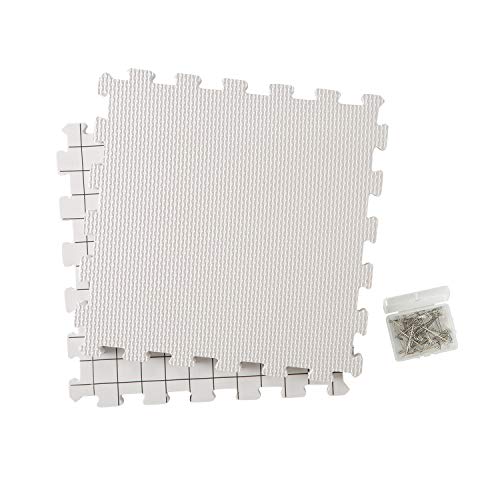
Knit Picks Premium Blocking Mats, 9 pack with T-pins
$51.11Gridded 12 by 12 inch mats with T-pins for pinning a washed swatch flat and measuring it.
Check price
HiyaHiya Sharp Interchangeable Needle Set, Expanded, 5 inch tips
$249.95Sharp steel tips from US 2 to 15 with four cable lengths: every gauge from socks to chunky in one case.
Check pricePrices change often, so confirm on Amazon. As an Amazon Associate we earn from qualifying purchases.
Fine gauge knitting: small needles and good light
At 23 or more stitches per 4 inches you are in fingering and sport territory, where sharp small tips and bright, true color light make counting easier.

ChiaoGoo Twist Red Lace Interchangeable Set, Complete, 5 inch tips
$216.80Stainless steel tips from US 2 (2.75 mm) to 15 with swiveling cables, a favorite for fine, even stitches.
Check price
ChiaoGoo Twist Red Lace Double Point Needle Set, 6 inch, US 0 to 3
$74.89Six inch steel double points in US 0 to 3 for swatching socks and small tubes in the round.
Check price
Daylight Company Slimline 4 LED Floor Lamp
$224.99A 6,000K floor lamp with a CRI of 95+ and 3,200 lux at 30 cm, so tiny stitches are easier to count.
Check pricePrices change often, so confirm on Amazon. As an Amazon Associate we earn from qualifying purchases.
Bulky gauge: big needles, or let a machine knit it
At 15 stitches per 4 inches or fewer, projects grow fast, and a crank machine can turn out panels and tubes of chunky yarn in a fraction of the time.
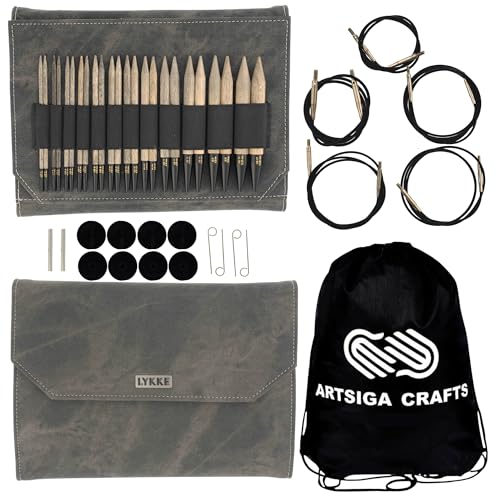
Lykke Driftwood 5 inch Interchangeable Circular Needle Set, US 4 to 17
$138.97Birch tips from US 4 to 17 (3.5 to 12 mm), reaching the large sizes most interchangeable sets stop short of.
Check price
addi Express Kingsize Knitting Machine, 46 needles
$157.12A 46 needle knitting machine that works a 13.8 inch tube or a 17.7 inch flat panel.
Check price
Lion Brand Wool-Ease Thick & Quick Yarn, 3 pack
$28.15Wool blend super bulky with a published gauge of 9 stitches on US 13 needles, a handy reference swatch yarn.
Check pricePrices change often, so confirm on Amazon. As an Amazon Associate we earn from qualifying purchases.
How do you calculate knitting gauge?
Gauge is the number of stitches and rows in a measured length of knitted fabric. Stitch gauge controls width, and row gauge controls length. Patterns and yarn labels usually quote it per 4 inches or per 10 cm, because a wider sample averages out the small variations between individual stitches. The calculator uses three formulas, and the numbers below are the same default swatch the results panel shows.
- Stitches per inch = stitches counted / width measured. 22 stitches over 4 inches is 5.5 stitches per inch. Rows work the same way: 30 rows over 4 inches is 7.5 rows per inch.
- Stitches needed = target width x stitches per inch, rounded to a whole stitch. A 20 inch panel needs 20 x 5.5 = 110 stitches, and 24 inches of length is 24 x 7.5 = 180 rows.
- Your count = pattern count x your gauge / pattern gauge. A pattern that casts on 100 stitches at 20 per 4 inches is 20 inches wide. At your gauge of 22, that width takes 100 x 22 / 20 = 110 stitches. If you kept the pattern's 100 stitches, your piece would come out only 18.2 inches wide.
When you measure in centimeters, the calculator converts to inches first (1 inch is 2.54 cm) and then reports both. A gauge of 22 stitches per 4 inches equals about 21.7 stitches per 10 cm, because 4 inches is slightly longer than 10 cm.
How do you measure a gauge swatch correctly?
Most gauge problems start with the swatch, not the math. A swatch that is too small, unwashed or measured at the edges gives a number the finished piece will never match.
- Knit it bigger than 4 inches. Cast on enough stitches for about 6 inches of width and knit about 6 inches of length, so you can measure a 4 inch patch in the middle, away from the cast on, bind off and edge stitches, which pull in.
- Use the pattern stitch and the pattern method. Stockinette, garter and ribbing all give different gauges on the same needles. If the project is knit in the round, knit the swatch in the round too, since many knitters work tighter or looser in the round than flat.
- Wash and dry it like the finished piece. Soak it, press out the water in a towel and lay it flat. Some yarns, especially superwash wool and plant fibers, grow noticeably when wet.
- Measure without stretching. Lay a ruler or gauge tool across the center, count full stitches, and if the edge of the ruler lands mid stitch, count the half. The calculator accepts half stitches.
If you do not want to measure exactly 4 inches, you do not have to. Count 17 stitches over 3.25 inches and enter both numbers: the calculator divides them for you, which is often more accurate than squinting at a partial stitch on a 4 inch mark. Our knitting needle size chart lists metric and US sizes if your swatch needle is only marked in one system.
What is the standard knitting gauge for each yarn weight?
The Craft Yarn Council publishes a gauge range for each numbered yarn weight in stockinette, together with the needle sizes most often used for it. Use it to sanity check your swatch: if your gauge sits well outside the range for the yarn on the label, recheck the count or the needle size. The last column uses the middle of each range to show roughly how many stitches a 20 inch wide piece takes.
| Yarn weight | Sts per 4 in | Sts per inch | Needles | Sts for 20 in (mid) |
|---|---|---|---|---|
| Lace (0) | 33 to 40 | 8.3 to 10 | 1.5 to 2.25 mm (US 000 to 1) | 183 |
| Super Fine (1) | 27 to 32 | 6.8 to 8 | 2.25 to 3.25 mm (US 1 to 3) | 148 |
| Fine (2) | 23 to 26 | 5.8 to 6.5 | 3.25 to 3.75 mm (US 3 to 5) | 123 |
| Light (3) | 21 to 24 | 5.3 to 6 | 3.75 to 4.5 mm (US 5 to 7) | 113 |
| Medium (4) | 16 to 20 | 4 to 5 | 4.5 to 5.5 mm (US 7 to 9) | 90 |
| Bulky (5) | 12 to 15 | 3 to 3.8 | 5.5 to 8 mm (US 9 to 11) | 68 |
| Super Bulky (6) | 7 to 11 | 1.8 to 2.8 | 8 to 12.75 mm (US 11 to 17) | 45 |
| Jumbo (7) | 6 or fewer | up to 1.5 | 12.75 mm and larger (US 17+) | 30 |
The ranges overlap on purpose. A light (DK) yarn knit firmly can land in the fine range, and a loosely knit worsted can drift toward bulky. The label weight tells you where to start; the swatch tells you where you are. For every weight's needle, hook and yardage details, see the yarn weight chart.
What happens if your gauge is off by a stitch or two?
The table below takes one pattern, a piece that casts on 100 stitches and is designed at 20 stitches per 4 inches for a 20 inch width. It shows how wide the piece comes out if you knit those 100 stitches at other gauges, and how many stitches you would cast on instead to keep it 20 inches wide.
| Your gauge per 4 in | Width with 100 sts | Difference | Sts for 20 in |
|---|---|---|---|
| 16 | 25 in | +5 in | 80 |
| 17 | 23.5 in | +3.5 in | 85 |
| 18 | 22.2 in | +2.2 in | 90 |
| 19 | 21.1 in | +1.1 in | 95 |
| 20 | 20 in | 0 in | 100 |
| 21 | 19 in | -1 in | 105 |
| 22 | 18.2 in | -1.8 in | 110 |
| 24 | 16.7 in | -3.3 in | 120 |
Two stitches per 4 inches sounds tiny, yet at 18 stitches the piece grows by +2.2 inches. On a sweater with a front and a back, that is roughly double. That is why the fix is usually to change needles rather than rescale: a pattern's shaping, stitch repeats and charts are all built on its gauge, and rescaling one count means rescaling every count.
More stitches than the pattern? Go up a needle size
If your swatch has more stitches per 4 inches than the pattern, your stitches are too small: try a larger needle. Fewer stitches means go down a size. Change one size at a time and swatch again, since yarns and knitters respond differently.
When should you rescale a pattern instead of changing needles?
Rescaling works well for simple shapes: blankets, scarves, cowls, plain hats and anything built from rectangles. Enter the pattern gauge and a stitch count in the calculator and it gives the count for your gauge. Do this for every number that sets a width, and for row counts if your row gauge differs too.
Rescaling gets harder when the pattern has a stitch repeat. A lace or cable panel might need a multiple of 12 stitches, so a rescaled count of 110 has to become 108 or 120, which changes the width again. Our cast on calculator rounds to a stitch multiple for you. For shaped garments, shaping rates are tied to row gauge, so the increase and decrease evenly calculator helps once you know the new counts.
Fine gauges make all of this harder on the eyes. Counting 30 or more stitches per 4 inches in dark yarn is where a good task light pays off, and a steel needle set like the ChiaoGoo Twist Red Lace Complete covers every size from US 2 up, so swatching one size larger or smaller costs nothing extra. For long sessions, the Daylight Slimline 4 Floor puts bright 6,000K light over the chair instead of the whole room.
Does gauge change for knitting in the round, ribbing or colorwork?
Often, yes. Ribbing pulls in, so its stitch gauge is not a useful measure of width; patterns quote gauge in stockinette or in the main stitch pattern. Stranded colorwork is usually tighter than plain stockinette because the floats carried behind the work limit how far the stitches can spread, so knitters commonly swatch the chart itself. And garter stitch is much more compressed vertically than stockinette, so its row gauge is quite different even when its stitch gauge is similar. Whenever a pattern gives gauge in a specific stitch, swatch in that stitch, then enter the result here.
Frequently asked questions
How do you calculate knitting gauge?
Count the stitches across and the rows up a measured section of a washed, blocked swatch, then divide each count by the length you measured. 22 stitches over 4 inches is 5.5 stitches per inch, or 22 per 4 inches. Multiply stitches per inch by any width to get a stitch count: 20 inches times 5.5 is 110 stitches.
What if my gauge does not match the pattern?
If you have more stitches per 4 inches than the pattern, your knitting is tighter, so try a larger needle. Fewer stitches means looser knitting, so try a smaller needle. Swatch again after each change. If you like the fabric, you can instead rescale the stitch counts: a pattern count of 100 at 20 stitches per 4 inches becomes 110 at 22.
How much does being one stitch off in gauge matter?
More than it looks. A 100 stitch piece planned at 20 stitches per 4 inches comes out 22.2 inches wide at 18 stitches instead of 20 inches. On a sweater body that is knit in the round, the difference is doubled because the front and back both grow, which is why a small gauge error can change a size.
Should I measure gauge before or after blocking?
After. Wash and dry the swatch the same way you will treat the finished piece, then measure it flat without stretching. Many yarns relax, bloom or grow when wet, and the stitch count per inch after blocking is the one the finished project will have. Measuring an unwashed swatch is the most common reason a finished sweater does not fit.
What is the difference between stitch gauge and row gauge?
Stitch gauge counts stitches across and controls width. Row gauge counts rows up and controls length and the spacing of shaping. Most patterns ask you to match stitch gauge first. Row gauge matters most in raglan yokes, sleeve caps and colorwork charts, where the pattern tells you to work a set number of rows rather than knit to a measured length.
Is 4 inches the same as 10 cm for gauge?
Close, but not identical. Four inches is 10.16 cm, so a gauge of 22 stitches per 4 inches is about 21.7 stitches per 10 cm. Patterns and yarn labels treat the two as interchangeable, and for a swatch the difference is less than one stitch. This calculator reports both so you can match whichever unit your pattern uses.
How we research: we compare manufacturer specifications, owner manuals, published standards and recurring themes in verified owner reviews. We do not test products in person, and this is researched guidance, not professional advice. Follow your machine manual and pattern, and take care with rotary cutters, hot irons and needles. As an Amazon Associate we earn from qualifying purchases.