Cast On Calculator: How Many Stitches for Hats, Socks and Sweaters
Multiply the finished measurement, after ease, by your stitches per inch and round to your stitch multiple. A 22 inch head with 2 inches of negative ease at 18 stitches per 4 inches is 90 stitches, so cast on 92 for 2x2 rib, a multiple of 4.
Enter the measurement you want the finished piece to fit, the ease, and your gauge from a washed swatch. Add the stitch multiple your rib or pattern needs and the calculator gives the cast on count, the nearest counts on either side, and how big each one comes out.
What are you knitting?
Your results
Cast on
20.4 in finished, 23 repeats of 4
| Target after ease | 20 in |
|---|---|
| Exact stitches | 90 |
| Smaller option | 88 sts, 19.6 in |
| Larger option | 92 sts, 20.4 in |
Needles for hats, socks and small circumferences
Under about 26 inches around, short circulars or double points keep the stitches from stretching across a long cable.

Clover Takumi Bamboo Circular Knitting Needle, 24 inch, US 8
$7.20A 24 inch bamboo US 8 circular, a handy length for cowls and worsted hats in the round.
Check price
HiyaHiya Flyers Flexible Double-Pointed Needles, Sock Set
$119.91Sharp 8 inch double points from 2.25 to 3 mm, a dedicated set for sock cuffs and mittens.
Check price
ChiaoGoo Twist Shorties Red Lace Interchangeable Set, 2 and 3 inch tips, US 0 to 3
$117.20Short 2 and 3 inch interchangeable tips in US 0 to 3 with 5, 6 and 8 inch cables for tiny circumferences.
Check pricePrices change often, so confirm on Amazon. As an Amazon Associate we earn from qualifying purchases.
Needles long enough for sweater bodies
A sweater body cast on needs a 24 to 32 inch cable or longer, and an interchangeable set gives you every size and length at once.
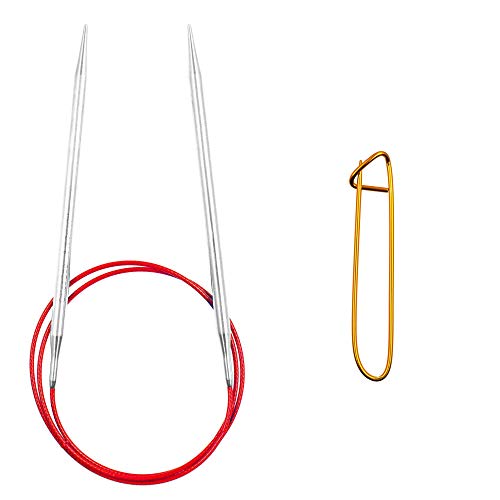
ChiaoGoo Red Lace Stainless Steel Circular Needle, 32 inch, US 9
$22.87A 32 inch stainless steel US 9 circular for sweater bodies and blankets in worsted.
Check price
Knit Picks Sunstruck Wood Interchangeable Needle Set, US 4 to 11
$77.47Nine pairs of tips from US 4 to 11 with 24, 32 and 40 inch cables.
Check price
HiyaHiya Sharp Interchangeable Needle Set, Expanded, 5 inch tips
$249.95Tips from US 2 to 15 with 16, 24, 32 and 40 inch cables, so any cast on fits.
Check pricePrices change often, so confirm on Amazon. As an Amazon Associate we earn from qualifying purchases.
A very wide cast on? Consider panels or a machine
Blankets and wraps with hundreds of stitches take a long time to cast on by hand. A crank machine knits long panels you can join.

addi Express Kingsize Knitting Machine, 46 needles
$157.12A 46 needle machine with a 17.7 inch flat mode for blanket panels.
Check price
Lion Brand Pound of Love Yarn, bulk 12 pack
$132.90Twelve skeins of worsted in one box, a bulk buy for big projects.
Check price
ChiaoGoo Twist Red Lace Interchangeable Set, Complete, 5 inch tips
$216.80Tips from US 2 to 15 with cables in two sizes, for long rows on any gauge.
Check pricePrices change often, so confirm on Amazon. As an Amazon Associate we earn from qualifying purchases.
How do you calculate how many stitches to cast on?
A cast on count is gauge times size, rounded so your stitch pattern fits. The calculator follows five steps. The numbers below are the default hat in the results panel: a 22 inch head, 2 inches of negative ease, 18 stitches per 4 inches, knit in the round with 2x2 ribbing.
- Apply the ease. Finished size = body measurement + ease. 22 + (-2) = 20 inches.
- Convert gauge to stitches per inch. 18 stitches per 4 inches is 4.5 stitches per inch.
- Multiply. 20 x 4.5 = 90 stitches exactly.
- Round to the stitch multiple. 2x2 rib in the round needs a multiple of 4. The nearest multiples are 88 (a finished 19.6 inches) and 92 (20.4 inches). When the exact count sits halfway, the calculator goes up, since ribbing pulls in anyway. Cast on 92.
- Add selvedge stitches for flat pieces. In the round, add none. A flat piece that will be seamed usually gets one extra stitch at each edge.
Here is a flat example to compare. A 40 inch wide sweater back piece at the same gauge with 2x2 rib worked flat (a multiple of 4 plus 2) and 2 selvedge stitches: 40 x 4.5 = 180, which already fits 4 plus 2, so the pattern count is 182 and you cast on 184.
How much ease should a hat, sock or sweater have?
Ease is the difference between the finished knitting and the body underneath. Knitted fabric stretches, so pieces that need to stay put are made smaller than the body, and pieces that should drape are made larger.
- Hats are usually knit with negative ease so the brim grips. Patterns commonly subtract an inch or two from the head measurement; very stretchy ribbing can take a little more.
- Socks and mittens also use negative ease around the foot or hand, so they do not bag or twist as you move.
- Sweaters are generally sized with positive ease at the chest. A close fit adds little, a classic fit adds a few inches, and an oversized style adds more. The pattern's schematic lists the finished chest for each size, and that finished number minus your chest is the ease the designer intended.
- Scarves, blankets and wraps have no body to fit. Enter the width you want and an ease of 0.
Stitch pattern changes how ease behaves. Ribbing stretches far more than stockinette, and cables pull in. That is why a pattern's gauge is given in a specific stitch: make sure the gauge you enter is from a swatch in the main body stitch, not the rib. If you are not sure of your gauge, work it out first with the knitting gauge calculator.
How many stitches to cast on for a 20 inch hat in every yarn weight?
This table uses the middle of the Craft Yarn Council knit gauge range for each weight and a 20 inch finished circumference, which is the default hat above after ease. Your swatch gauge will differ, so treat these as a starting point and run your own numbers.
| Yarn weight | Gauge per 4 in | Exact sts | 1x1 rib (x 2) | 2x2 rib (x 4) | Size at x 4 |
|---|---|---|---|---|---|
| Super Fine (1) | 29.5 | 147.5 | 148 | 148 | 20.1 in |
| Fine (2) | 24.5 | 122.5 | 122 | 124 | 20.2 in |
| Light (3) | 22.5 | 112.5 | 112 | 112 | 19.9 in |
| Medium (4) | 18 | 90 | 90 | 92 | 20.4 in |
| Bulky (5) | 13.5 | 67.5 | 68 | 68 | 20.1 in |
| Super Bulky (6) | 9 | 45 | 46 | 44 | 19.6 in |
Cast on stitches by width and gauge
For plain pieces with no stitch multiple, such as a garter scarf, a stockinette panel or a blanket center, this chart gives the count directly. Widths include ease, gauges are stitches per 4 inches, and every figure is rounded to the nearest whole stitch.
| Width (in) | 16 sts / 4 in | 18 sts / 4 in | 20 sts / 4 in | 22 sts / 4 in | 24 sts / 4 in |
|---|---|---|---|---|---|
| 8 | 32 | 36 | 40 | 44 | 48 |
| 20 | 80 | 90 | 100 | 110 | 120 |
| 36 | 144 | 162 | 180 | 198 | 216 |
| 44 | 176 | 198 | 220 | 242 | 264 |
| 50 | 200 | 225 | 250 | 275 | 300 |
Make the cast on edge stretch as much as the rib
A tight cast on is the most common reason a hat brim or sock cuff will not go on. Use a stretchy method such as the long tail over two needles held together, or cast on with a needle a size or two larger, then switch back for the first row.
What is a stitch multiple, and why does it change the cast on?
A stitch multiple is the number of stitches in one repeat of a pattern. Ribbing, seed stitch, lace and cables all need a count that divides into whole repeats, or the pattern breaks at the edge or the join. Patterns write it as "a multiple of 6 plus 3": some number of 6 stitch repeats, plus 3 stitches to balance the edges.
Common ones: 1x1 rib uses a multiple of 2 in the round and 2 plus 1 flat. 2x2 rib uses 4 in the round and 4 plus 2 flat. Seed stitch works over an even count in the round and an odd count flat for matching edges. Lace and cable panels state their own multiples in the chart key.
Rounding to a multiple always moves you away from the exact size. With a small multiple the change is tiny, but a multiple of 12 at a bulky gauge can shift the size by more than an inch either way. The results panel shows both neighbors so you can choose. A cozy hat may be better on the smaller count; a sweater hem is better on the larger. Once you know the count, the increase or decrease evenly calculator spaces the shaping from rib to body.
Which needles make a big cast on easier?
Long cast ons are where needle length matters. Hats and socks want a short 16 inch circular or double points, while a sweater body in the round needs 24 to 32 inches of cable so the stitches are not stretched. If you knit many different projects, an interchangeable set pays for itself quickly: the HiyaHiya Sharp Expanded 5" covers US 2 to 15 with cables from 16 to 40 inches, and the Knit Picks Sunstruck Set is the lower cost way into mid sizes. For blankets that would need hundreds of stitches, knitting panels on the addi Express Kingsize and joining them is a popular shortcut.
Frequently asked questions
How many stitches do I cast on for a hat?
Measure around the head, subtract the negative ease you want, and multiply by your stitches per inch. A 22 inch head with 2 inches of negative ease is a 20 inch hat. At 18 stitches per 4 inches, that is 20 x 4.5 = 90 stitches, which rounds to 88 or 92 for 2x2 rib. The calculator picks 92, about 20.4 inches around.
How do you calculate cast on stitches from gauge?
Divide your gauge by 4 to get stitches per inch, then multiply by the finished width or circumference, including ease. Round the result to the stitch multiple your pattern needs, and add selvedge stitches if the piece is flat and will be seamed. Always use gauge from a washed swatch, because a gauge that is half a stitch off changes a sweater body by a couple of inches.
What is negative ease in knitting?
Ease is the difference between the finished piece and the body it fits. Negative ease means the knitting is smaller than the body, so it stretches to hold on: hats, socks, mittens and fitted ribbing all rely on it. Positive ease means the piece is bigger than the body, which is how most sweaters are sized. The calculator accepts negative numbers in the ease field.
Why do flat 2x2 rib patterns use a multiple of 4 plus 2?
In the round, a multiple of 4 lets knit 2, purl 2 repeat without a seam in the pattern. Worked flat, a multiple of 4 plus 2 lets both edges begin with the same 2 knit stitches, so the ribbing looks symmetrical and lines up across a seam. For 1x1 rib flat, a multiple of 2 plus 1 does the same job. Enter the multiple and the plus value to get a count that fits.
Do cast on stitches count as a row?
Usually not. Most patterns count rows from the first row worked after the cast on, even though a long tail cast on looks like a finished row on the needle. Some patterns do count it, and they say so. For gauge and length, measure the fabric rather than relying on a row count that includes the cast on, and count rows from the first full row above it.
Should I include selvedge stitches in my cast on?
Add them on top of the count for flat pieces that will be seamed or picked up along the edge, usually one stitch on each side. Those stitches disappear into the seam, so they should not count toward the finished width. For the 40 inch flat example on this page, the pattern count is 182 and the cast on with 2 selvedge stitches is 184. Skip selvedge stitches when knitting in the round.
How we research: we compare manufacturer specifications, owner manuals, published standards and recurring themes in verified owner reviews. We do not test products in person, and this is researched guidance, not professional advice. Follow your machine manual and pattern, and take care with rotary cutters, hot irons and needles. As an Amazon Associate we earn from qualifying purchases.