Curtain Fabric Calculator: Yardage by Width, Fullness, Hems and Repeat
Multiply the rod width by the fullness, divide by the usable fabric width to get the number of widths, then multiply by the cut length. Two 84 inch pinch pleat panels for a 72 inch window at 2.5x fullness need 4 widths of 54 inch fabric cut 100 inches long: about 11 1/8 yd.
Measure your rod, choose a heading style and enter your fabric width. The calculator works the way drapery workrooms do: it counts whole and half widths of fabric, adds hems and heading, rounds every cut to your pattern repeat, and gives a total you can buy.
Your window and fabric
Your results
Fabric to buy
4 cuts of 100 in, about 10.2 m
| Flat width, all panels | 180 in |
|---|---|
| Flat width per panel | 96 in with hems |
| Widths per panel | 2 (1.81 exact) |
| Cut length | 100 in |
| Added by the repeat | 0 yd |
Sewing lined or heavy drapery
Eight to twenty yards of decor fabric is heavy to feed and long to cut. A heavy-duty machine, a long mat and a strong iron do most of the work.

Janome HD3000 Heavy Duty Sewing Machine with Hard Case
$529.00A heavy-duty machine with adjustable foot pressure for blackout lining and decor weights.
Check price
Olfa 35 x 70 Continuous Grid Connecting Rotary Mat Set
$209.99Connecting mats assemble to 35 x 70 inches, long enough to square up drapery widths.
Check price
Oliso TG1600 Pro Plus Auto-Lift Steam Iron
$199.99An auto-lift steam iron that saves your wrist on long hems and pleated headings.
Check pricePrices change often, so confirm on Amazon. As an Amazon Associate we earn from qualifying purchases.
Unlined panels and cafe curtains
Smaller curtain projects fit a good home machine and a standard mat.
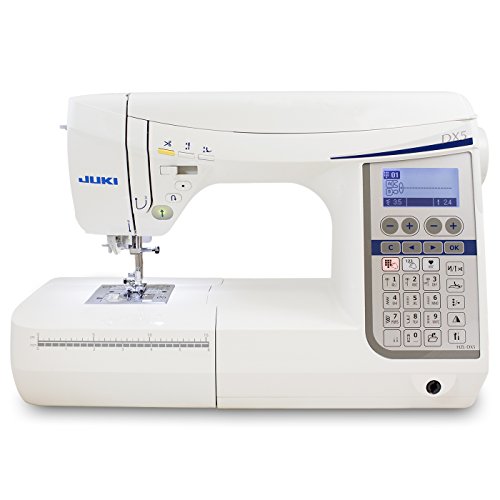
Juki HZL-DX5 Computerized Sewing Machine
$1,099.00Adjustable foot pressure and an automatic one-step buttonhole for tab and tie tops.
Check price
Olfa 24 x 36 Self-Healing Rotary Mat RM-MG
$59.99A 24 x 36 inch self-healing mat for trimming hems and tabs.
Check price Oliso TG1600 Pro Plus Auto-Lift Steam Iron
$199.99Crisp hems before stitching make panels hang straight.
Check pricePrices change often, so confirm on Amazon. As an Amazon Associate we earn from qualifying purchases.
Whole-house or workroom quantities
Past about twenty yards you are running a small workroom. A standing cutting table and an industrial straight stitch save real hours.

Sew Ready Fabric Cutting Standing Table with Craft Organizers
$369.99A folding standing cutting table with locking casters and storage baskets.
Check price
Juki DDL-8700 Industrial Straight Stitch Sewing Machine
$1,099.00An industrial straight stitch rated to 5,500 stitches per minute for long seams.
Check price
Rowenta Master Steam Station VR8338
$199.99A steam station for steaming panels once they are hung.
Check pricePrices change often, so confirm on Amazon. As an Amazon Associate we earn from qualifying purchases.
How do you calculate fabric for curtains?
Curtain yardage is calculated in widths. A width is one full-length cut of fabric from selvage to selvage, and panels are built by seaming widths side by side. Working in widths rather than square footage matters because you cannot use a leftover strip from one cut to make up a shortfall in another; each width must run the full drop of the curtain.
The method used by drapery workrooms has five steps. Every number below comes from the same function that powers the calculator, using its default window.
- Find the flat width. Multiply the rod width by the fullness. A 72 inch rod at 2.5x fullness needs 180 inches of fabric before hems.
- Split it into panels and add side hems. Two panels share that width, so each needs 90 inches, plus 6 inches for double 1 1/2 inch side hems: 96 inches per panel.
- Count the widths. Divide by the usable width. Each seam and selvage trim costs about an inch, so 54 inch fabric gives 53 usable inches. 96 divided by 53 is 1.81, which rounds up to 2 widths per panel and 4 cuts in total. Workrooms round to the nearest half width, because a half width can be split down the middle and shared by a pair of panels.
- Find the cut length. Add the bottom hem and heading to the finished length: 84 + 8 + 8 = 100 inches. With a pattern repeat, round up to a whole number of repeats.
- Multiply and convert. 4 cuts of 100 inches is 400 inches, or 11 1/8 yd after rounding up to the next eighth of a yard.
If you are measuring for the first time, measure the rod rather than the window glass. Most rods extend 3 to 6 inches past the frame on each side so the stacked curtains clear the glass when open, and that extension is part of the width you need to cover. For finished length, measure from the bottom of the rings or the top of the rod to where you want the hem: a half inch above the floor for a crisp look, touching it for a relaxed break, or several inches onto it for a puddle.
How much curtain fabric do I need for my window size?
The chart below uses pinch pleat drapery at 2.5x fullness, two panels, 54 inch plain fabric, a double 4 inch hem and an 8 inch heading. Read across for your finished length. The steps are uneven because the answer jumps each time a panel needs another half width.
| Rod width | Widths | 63 in long | 84 in long | 95 in long | 108 in long |
|---|---|---|---|---|---|
| 36 in | 2 | 4 1/2 yd | 5 5/8 yd | 6 1/4 yd | 7 yd |
| 48 in | 3 | 6 5/8 yd | 8 3/8 yd | 9 1/4 yd | 10 3/8 yd |
| 60 in | 4 | 8 7/8 yd | 11 1/8 yd | 12 3/8 yd | 13 7/8 yd |
| 72 in | 4 | 8 7/8 yd | 11 1/8 yd | 12 3/8 yd | 13 7/8 yd |
| 96 in | 5 | 11 yd | 14 yd | 15 1/2 yd | 17 1/4 yd |
| 120 in | 6 | 13 1/4 yd | 16 3/4 yd | 18 1/2 yd | 20 3/4 yd |
Stock curtain lengths of 63, 84, 95 and 108 inches line up with the curtain panel yardage chart, which covers single flat panels on standard widths. Use this calculator when you want real drapery fullness, lined panels or a patterned fabric.
What fullness should I use for each curtain heading?
Fullness is the ratio of flat fabric width to rod width. It controls how deep the folds are when the curtain is closed, and it is the single biggest driver of how much fabric you buy. Heading style sets a sensible range: grommets need enough fabric to fold between rings, while pinch pleats consume width inside every pleat.
| Heading style | Fullness | Heading allowance | Cuts | Yards | Notes |
|---|---|---|---|---|---|
| Flat panel or tie top | 1.5x | 4 in | 3 x 96 in | 8 yd | Double 2 in turn at the top |
| Tab top | 1.5x | 4 in | 3 x 96 in | 8 yd | Tabs cut separately; 2 in facing turned twice |
| Grommet | 2x | 8 in | 3 x 100 in | 8 3/8 yd | Double 4 in heading with interfacing |
| Rod pocket with header | 2.5x | 10 in | 4 x 10² in | 11 3/8 yd | 3 in pocket plus 1 1/2 in header, doubled, plus turn-under |
| Pinch pleat | 2.5x | 8 in | 4 x 100 in | 11 1/8 yd | Double 4 in buckram heading |
| Sheer, extra full | 3x | 8 in | 5 x 100 in | 14 yd | Double 4 in heading; sheers look thin below 2.5x |
These are planning figures published widely by drapery workrooms and pattern companies, and they vary. Grommet and ripple-fold hardware makers often print their own fullness charts, so follow the instructions for the tape or rings you bought. As a comparison, the same window with grommets at 2x uses 8 3/8 yd, and sheers at 3x use 14 yd.
How does a pattern repeat change curtain yardage?
A pattern repeat is the distance down the fabric before the design starts again, printed on the selvage or the bolt label as a vertical repeat. When panels hang side by side, the motifs must line up across every seam and across the pair, so every cut has to start at the same point in the design. That means each cut length rounds up to a whole number of repeats, and you need one more repeat to put the first motif where you want it, usually a full motif just below the heading.
| Repeat | Cut length | Total yards | Added by the repeat |
|---|---|---|---|
| Plain | 100 in | 11 1/8 yd | 0 yd |
| 6.75 in | 101.25 in | 11 1/2 yd | 3/8 yd |
| 13.5 in | 108 in | 12 3/8 yd | 1 1/4 yd |
| 20.5 in | 102.5 in | 12 yd | 7/8 yd |
| 27 in | 108 in | 12 3/4 yd | 1 5/8 yd |
A small repeat can cost almost nothing if the raw cut already lands close to a multiple, while a large one can add yards. With a 13 1/2 inch repeat the default window needs 12 3/8 yd; with a 27 inch repeat it needs 12 3/4 yd. Fabric width matters too: the same pair on 45 inch fabric takes 5 cuts and 14 yd.
Buy all your fabric from one bolt
Dye lots vary between bolts, and the difference shows when two panels hang side by side in window light. Buy the full amount at once, add a little for straightening a crooked print, and ask the shop to check that the print is square to the selvage before cutting.
Do lined and blackout curtains need extra fabric?
Lining is calculated the same way, usually with the same number of widths. Lining is often cut 2 to 3 inches shorter than the face fabric and hemmed separately so it never peeks below the curtain, and it has no pattern repeat, so it costs the plain figure. Interlining, the soft flannel layer between face and lining, is also cut to the plain figure. For our default window that means about 11 1/8 yd each of lining and interlining on top of the face fabric.
Heavy layers are where machine and workspace choices matter. Three layers of decor fabric at the heading, plus buckram, is thick for a light machine. A heavy-duty machine such as the Janome HD3000 has adjustable foot pressure for bulky layers, and a long cutting surface such as the Olfa 35 x 70 connecting mat set lets you square a full width without sliding fabric off the edge. For pressing long double hems, an auto-lift iron like the Oliso TG1600 Pro Plus spares your wrist from lifting on every pass.
How do I cut curtain widths straight?
Straighten the cut end first by pulling a thread or cutting along a printed line, then measure every cut from that edge. Mark all cuts before you cut any, because an error found after the first cut is cheap to fix and one found after the fourth is not. Cut selvages off or clip them every few inches before seaming, since tightly woven selvages pucker and make the seam draw up. Join widths with the pattern matched at the seam line, not the cut edge, and press seams open. When you have a half width, place it at the outer edge of each panel so the seam falls in a fold rather than the middle of the window.
Frequently asked questions
How much fabric do I need for curtains?
Work it out in widths, not square feet. For a 72 inch window with two pinch pleat panels at 2.5x fullness, each panel needs 96 inches of flat fabric including side hems, which is 2 widths of 54 inch fabric. Four cuts at 100 inches (finished length plus hem and heading) come to about 11 1/8 yd. Patterned fabric adds more.
How much fullness should curtains have?
Flat panels and tab tops usually use 1.5 times the rod width, grommet curtains about 2 times, and rod pocket or pinch pleat drapery 2 to 2.5 times. Sheers look best at 2.5 to 3 times because thin fabric needs more folds to look rich. Fuller curtains use more fabric but hang in deeper, softer folds; skimpy fullness is the most common homemade curtain regret.
How do I calculate curtain fabric with a pattern repeat?
Round each cut length up to a whole number of repeats so every width starts at the same point in the design, then add one extra repeat to place the first motif where you want it. A 100 inch cut with a 27 inch repeat becomes 108 inches. For our default window that raises the total from 11 1/8 yd to 12 3/4 yd.
How much do you add for curtain hems?
A common drapery workroom allowance is a double 4 inch bottom hem, which uses 8 inches of length, and double 1 1/2 inch side hems, which use 6 inches of width per panel. The heading adds more: about 8 inches for a double 4 inch buckram or grommet heading and around 10 inches for a rod pocket with a header. Lightweight casual panels can use smaller hems.
Is 54 inch or 118 inch fabric better for curtains?
Standard 54 inch decor fabric is cut in vertical widths and seamed. Extra wide 118 inch sheer and voile fabric is often railroaded, turned sideways so the width becomes the drop, which removes seams entirely. For our default window, 54 inch fabric needs 11 1/8 yd while 118 inch fabric needs 5 5/8 yd when cut in widths; railroading can reduce that further for lengths under about 110 inches.
Do I need a special sewing machine for curtains?
Not for most curtains. Any sturdy machine handles cotton and linen panels. Lined drapery, blackout, velvet and interlined curtains are heavy and bulky, so a machine with a strong motor and adjustable presser foot pressure makes long straight seams much easier. Floor space and a large cutting surface matter as much as the machine, because a single cut can be over 100 inches long.
How we research: we compare manufacturer specifications, owner manuals, published standards and recurring themes in verified owner reviews. We do not test products in person, and this is researched guidance, not professional advice. Follow your machine manual and pattern, and take care with rotary cutters, hot irons and needles. As an Amazon Associate we earn from qualifying purchases.