Janome 8002D vs Brother 1034D: Which Budget Serger Should You Buy?
The Brother 1034D, about $285, is the better value first serger for most sewists: 3 or 4 threads, 1,300 SPM, a ribbon lock stitch and 3 feet included. Choose the Janome 8002D, about $360, if you have a local Janome dealer or want its published 0.5 to 2.25 differential feed and retractable upper knife.
The verdict
The 1034D is the better buy for most first-time serger owners, because it matches the 8002D on the essentials and costs about $75 less with more feet in the box. The 8002D is the better buy if you want a local dealer for lessons and service.
These are near twins. Both are mechanical 3 or 4 thread sergers with differential feed, rolled hems and 1,300 stitches per minute, and both weigh about 13.4 lb. Nobody will be able to tell which one sewed your T-shirt seams.
Janome 8002D vs Brother 1034D: side by side
| Feature | Janome 8002D | Brother 1034D |
|---|---|---|
| Price | About $360 | About $285 |
| Thread options | 3 or 4 | 3 or 4 |
| Max speed | 1,300 SPM | 1,300 SPM |
| Stitch or cutting width | 3.1 to 7.3 mm cutting width | 3 to 7 mm stitch width |
| Stitch length | 1 to 4 mm | Not published in the specs we verified |
| Differential feed | 0.5 to 2.25 ratio | Yes, ratio not published |
| Rolled hem | Quick change rolled hem | Rolled hem conversion |
| Knife | Easily retractable upper knife | Built-in knife |
| In the box | Pre-threaded, 4 starter spools, foot control, screwdrivers | 3 feet, 4 spools of serger thread, soft cover, trim trap |
| Weight | 13.4 lb | 13.45 lb |
Is the Janome 8002D better than the Brother 1034D?
Not in any way a stitch will show. Janome publishes more of its numbers: a 0.5 to 2.25 differential feed ratio, a 1 to 4 mm stitch length and a 3.1 to 7.3 mm cutting width. Brother lists differential feed and a 3 to 7 mm stitch width on the 1034D, plus a ribbon lock stitch and standard, blindstitch and gathering feet.
The recurring differences in owner reviews are small. 8002D owners often mention clearly marked tension dials and a machine that arrives pre-threaded. 1034D owners frequently mention the gathering foot as a bonus and describe some rattle at full speed. Both groups describe the lower looper as the part that takes practice.
| Job | [[janome-8002d]] | [[brother-1034d]] | Notes |
|---|---|---|---|
| T-shirt and leggings seams | Excellent | Excellent | Both 4 thread overlock with differential feed |
| Finishing woven seam allowances | Excellent | Excellent | 3 thread overlock on both |
| Rolled hems on napkins | Very good | Very good | Janome calls its conversion quick change |
| Gathering ruffles | Differential feed | Gathering foot included | Brother saves a foot purchase |
| Sewing without trimming | Retractable upper knife | Check manual for knife disengaging | Useful for decorative edges |
| 2 thread stitches | No | No | Step up to a 2/3/4 thread model |
| Local lessons and service | Janome dealers | Brother service centers and dealers | Depends on your area |
Which budget serger is easiest to thread?
Neither is effortless. Both use color-coded threading paths. Janome ships the 8002D pre-threaded, and on either machine you can tie new thread onto the old and pull it through instead of starting from scratch. That tie-on method is the single most useful serger habit, and the manuals for both show it.
If rethreading loopers from scratch is what keeps a serger in the closet, the jump that truly changes the experience is air threading. The Janome AirThread 2000D (about $1,399) and the Brother AIR1800 (about $900) blow thread through the loopers at the press of a button. The Janome MyLock 634D, about $699, is a middle step with a self-threading lower looper and 2-thread capability.
Is a budget serger enough, or should you spend more?
For most home sewists a budget serger is enough for years. The upgrades worth paying for are specific: 2-thread stitches for fine fabric, air threading for comfort, or heavier construction for daily production. The Juki MO-654DE adds 2-thread capability and a published 1,500 SPM speed for about $599.
Pair any serger with cone thread made for sergers; a 4-pack of Maxi-Lock cones sets up a full 4 thread overlock. Our how to use a serger guide walks through tensions and threading order.
Choose Janome 8002D if
- You have a Janome dealer nearby for lessons and service.
- You want published differential feed and stitch length ranges.
- You like a retractable upper knife for sewing without trimming.
- You prefer Janome's tension dial layout.
Choose Brother 1034D if
- You want the lowest price on a proven first serger.
- You want a gathering foot and blindstitch foot included.
- You want a ribbon lock decorative stitch.
- You would rather spend the savings on serger thread.
Our serger picks by budget

Brother 1034D Serger
$284.99The value first serger with 3 feet and 1,300 SPM for about $285.
Check price
Janome 8002D Serger
$360.00A dealer-brand twin with published 0.5 to 2.25 differential feed.
Check price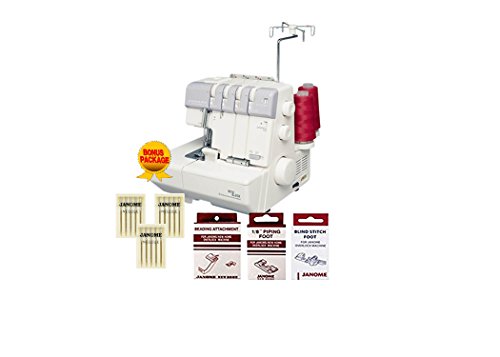
Janome MyLock 634D Serger
$699.00Adds 2-thread stitches and a self-threading lower looper.
Check price
Brother AIR1800 Air Threading Serger
$899.99Air looper threading at the press of a button.
Check price
Janome AirThread 2000D Serger
$1,399.00One-push air threading, an 8-piece feed dog and a built-in needle threader.
Check pricePrices change often, so confirm on Amazon. As an Amazon Associate we earn from qualifying purchases.
This comparison is drawn from published specifications, owner manuals and the consensus of verified owner reviews, not side-by-side testing.
Frequently asked questions
Is the Janome 8002D good for beginners?
Yes. The Janome 8002D is a straightforward mechanical 3 or 4 thread serger that arrives pre-threaded with 4 starter spools, which lets beginners tie on new thread rather than threading from scratch. Owners frequently praise its clearly marked tension dials. It lacks 2-thread stitches and air threading, which most beginners do not need.
Does the Brother 1034D come with a gathering foot?
Yes. Brother lists three feet with the 1034D: standard, blindstitch and gathering. A gathering foot lets you gather a ruffle and attach it to a flat piece in a single pass. The machine also includes 4 spools of serger thread, a soft cover, a trim trap, tweezers and thread nets, per Brother.
What is differential feed on a serger?
Differential feed uses two sets of feed dogs, front and back, that can move at different speeds. Setting the front faster gathers or eases knits so seams stay flat instead of wavy; setting it slower stretches light fabrics slightly to prevent puckering. Janome publishes a 0.5 to 2.25 ratio for the 8002D, and Brother lists differential feed on the 1034D.
Can a serger replace a sewing machine?
No. A serger like the 1034D or 8002D sews, trims and overcasts seams, but it cannot sew buttonholes, insert zippers neatly, topstitch or quilt. Most garment sewists use both: the sewing machine for construction details and the serger for fast, stretchy, finished seams. Buy the sewing machine first if you own neither.
What thread should I use in a budget serger?
Use cone thread made for sergers, usually spun polyester, because a serger uses 3 or 4 spools at once and small spools run out fast. A 4-cone set in a neutral color covers most projects. You can use regular spools in the needles in a pinch. Check the manual for the 1034D or 8002D for the recommended needle type and size.
Sources
How we research: we compare manufacturer specifications, owner manuals, published standards and recurring themes in verified owner reviews. We do not test products in person, and this is researched guidance, not professional advice. Follow your machine manual and pattern, and take care with rotary cutters, hot irons and needles. As an Amazon Associate we earn from qualifying purchases.