How Much Binding for a Baby Quilt?
A 40 x 40 inch baby quilt has a 160 inch perimeter. With 12 inches extra for corners and joining, cut 5 strips 2 1/2 inches wide across 42 inch fabric, which uses 3/8 yards. For continuous bias binding, start with a 26 inch square of fabric.
Binding wraps the raw edges of the quilt sandwich. This page covers a baby quilt of 40 x 40 inches. For any other size, the quilt binding calculator uses the same formula.
| Quilt perimeter | 160 in (4.4 yd) |
|---|---|
| Binding length to make | 172 in, including 12 in extra |
| Strips (2 1/2 in wide) | 5 |
| Fabric needed | 3/8 yd |
| Bias binding square | 26 x 26 in |
How much binding do you need for each strip width?
Wider strips suit thicker batting. Each diagonal join uses about one strip width of length, which is already included below. Strips are cut across 42 inch cotton with about 40 inches usable.
| Strip width | Strips | Straight-grain yardage | Bias square |
|---|---|---|---|
| 2 in | 5 | 3/8 yd | 23 in |
| 2 1/4 in | 5 | 3/8 yd | 25 in |
| 2 1/2 in | 5 | 3/8 yd | 26 in |
| 2 3/4 in | 5 | 1/2 yd | 28 in |
| 3 in | 5 | 1/2 yd | 29 in |
How do you bind a baby quilt, step by step?
- Cut the strips. Cut 5 strips 2 1/2 inches wide across the width of the fabric, selvage to selvage, using a rotary cutter, mat and long ruler.
- Join the strips on the diagonal. Lay two strips right sides together at a right angle, sew corner to corner, trim to a 1/4 inch seam and press open. Diagonal seams spread the bulk so the binding lies flat.
- Fold and press. Fold the long strip in half lengthwise, wrong sides together, and press. You now have about 190 inches of double-fold binding for a quilt that needs 172 inches.
- Sew to the quilt front. Starting partway down one side and leaving a 10 inch tail, sew the raw edges to the quilt front with a 1/4 inch seam, using a walking foot if you have one.
- Miter the corners. Stop 1/4 inch before each corner, backstitch, fold the binding up at 45 degrees and back down along the next edge, then continue sewing.
- Join the ends and finish. Overlap and join the tails, sew the last section down, then wrap the folded edge to the back and hand stitch or machine stitch it in place, holding it with binding clips.
For photos of every step and troubleshooting for wavy edges and bulky corners, read our full guide on how to bind a quilt.
What tools make binding a baby quilt easier?
Accurate strips start with a sharp rotary cutter and a long ruler. When you stitch the binding down, a machine with an even feed or walking foot keeps a quilt this size from shifting under the needle.
Tools for cutting and sewing baby binding
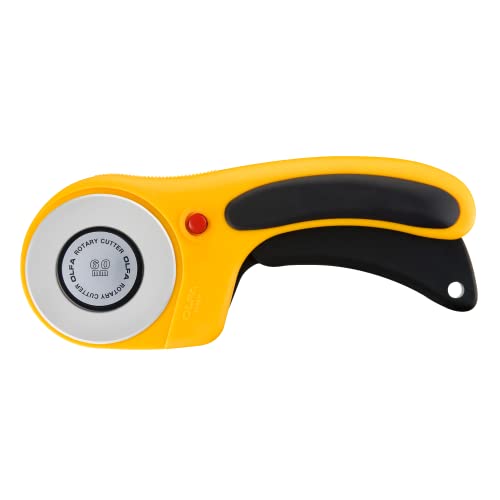
Olfa 60mm Ergonomic Squeeze-Handle Rotary Cutter RTY-3/DX
$26.49A 60 mm blade cuts through several layers of binding fabric at once.
Check price
Creative Grids 12-1/2 x 24-1/2 Rectangle Quilt Ruler
$55.99A 24 inch non-slip ruler for straight, true strips.
Check price
Clover Wonder Clips (50 Pack)
$16.95Clips hold folded binding without pin pricks while you hand stitch.
Check pricePrices change often, so confirm on Amazon. As an Amazon Associate we earn from qualifying purchases.
Frequently asked questions
How many binding strips do I need for a baby quilt?
For a 40 x 40 inch baby quilt, cut 5 strips of 2 1/2 inch binding across 42 inch fabric. The math is the perimeter of 160 inches plus 12 inches for corners and the final join, divided by about 37.5 usable inches per strip after the diagonal seams. Round up, and cut one extra if your fabric is narrow after prewashing.
How much fabric do I need for baby quilt binding?
5 strips at 2 1/2 inches wide use 12.5 inches of fabric, which rounds up to 3/8 yards. Wider 2 3/4 inch strips, popular for thick batting, need 5 strips and 1/2 yards. Buy the binding fabric with the rest of the quilt so the dye lot matches.
What width should quilt binding strips be?
Two and a half inch double-fold binding is the most common choice and finishes about 3/8 inch wide on a quilt with average batting. Use 2 1/4 inches for a slimmer look on thin cotton batting, and 2 3/4 to 3 inches for high-loft or wool batting. Always test a short length on a scrap sandwich first.
Do I need bias binding for a baby quilt?
Only if the quilt has curved or scalloped edges, or you want a very durable edge for a quilt that will be washed often. Straight-grain strips cut across the width of fabric are perfectly fine for square corners. Bias binding needs more fabric handling, and for this size you would cut it from a square about 26 inches on each side.
Should I sew binding by hand or by machine?
Both are sound. Machine binding is faster and very durable, which suits quilts that will be used and washed often. Hand stitching the back gives an invisible finish that many quilters prefer for heirloom and show quilts. A walking foot helps keep the layers even when sewing the binding to the front, whichever finish you choose.
How we research: we compare manufacturer specifications, owner manuals, published standards and recurring themes in verified owner reviews. We do not test products in person, and this is researched guidance, not professional advice. Follow your machine manual and pattern, and take care with rotary cutters, hot irons and needles. As an Amazon Associate we earn from qualifying purchases.