Best Multi-Needle Embroidery Machine (2026): 6 Picks for Home and Shop
The best multi-needle embroidery machine for home use is the Janome MB-7, about $5,999, with seven needles, a 9.4 x 7.9 in field and Tajima hoop support. For the most needles per dollar, the 15-needle Poolin EOM-15 costs about $3,994, and the Ricoma Swift 1501 has the largest field here at 20.5 x 13.8 in.
A multi-needle embroidery machine holds several thread colors at once and switches between them automatically. For a home studio, the Janome MB-7 at about $5,999 is our top pick: seven needles, a 9.4 x 7.9 in field, a jumbo bobbin, automatic jump-thread trimming and support for Tajima industry hoops, all backed by Janome's dealer network.
If you are buying for production rather than a home studio, the 15-needle Poolin EOM (about $3,994) and the Ricoma Swift 1501 (about $6,499) give you more needles and larger fields for the money. Below: how these machines work, how many needles you actually need, and who should stay with a single-needle machine.
Multi-needle embroidery machines at a glance
| Product | Price | Needles | Embroidery field | Max speed | Cap system | Buy |
|---|---|---|---|---|---|---|
 Poolin EOM Poolin EOM | $3,994.00 | 15 | 14.2 x 9.5 in | 1,200 spm flat, 850 spm caps | 270 degree | Price |
 Ricoma EM-1010 Ricoma EM-1010 | $4,499.00 | 10 | 12.2 x 8.3 in | Not listed | 220 degree | Price |
 Janome MB-4S Janome MB-4S | $4,999.00 | 4 | Not listed | Not listed | Hat hoop included | Price |
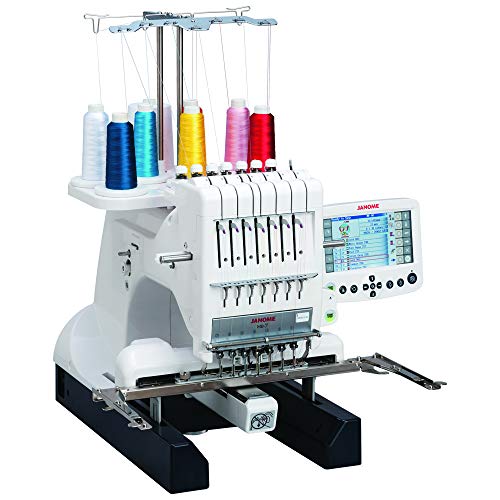 Janome MB-7 Janome MB-7 | $5,999.00 | 7 | 9.4 x 7.9 in | Not listed | Not listed | Price |
 Ricoma Swift 1501 Ricoma Swift 1501 | $6,499.00 | 15 | 20.5 x 13.8 in | 1,200 spm | 270 degree | Price |
 Brother PR680W Brother PR680W | $12,999.99 | 6 | 30 x 20 cm | 1,000 spm | Cap kit included | Price |
Beginner
Entry multi-needle: most needles for the money, about $4,000 to $4,500
"Beginner" here means your first multi-needle machine, not your first embroidery machine. These two deliver commercial-style features at the lowest current prices.
Poolin EOM 15-Needle Embroidery Machine
$3,994.0015 needles, 14.2 x 9.5 in area, 1,200 spm flat and 850 spm caps, a 270 degree cap system, laser positioning, a 9 in touchscreen and Wi-Fi. The lowest price per needle on this page.
Best for: Best value
Check price Ricoma EM-1010 10-Needle Embroidery Machine
$4,499.0010 needles, 12.2 x 8.3 in area, a 220 degree cap system, automatic color change and trimming and a 10.1 in touchscreen, plus a year of Chroma Inspire software. The stand is sold separately.
Best for: Starting a shop
Check pricePrices change often, so confirm on Amazon. As an Amazon Associate we earn from qualifying purchases.
Intermediate
Home-studio multi-needle: Janome MB series, about $5,000 to $6,000
Janome's MB machines are sized and styled for a home sewing room and sold through sewing dealers, which suits hobbyists who want automatic color changes without running a shop.
Janome MB-7 Seven-Needle Embroidery Machine
$5,999.00Seven needles, a 9.4 x 7.9 in field, jumbo bobbin, automatic jump-thread trimming, a 5.7 in remote computer screen for editing and Tajima industry hoop support. Reads JEF+ and DST.
Best for: Home studios
Check price Janome MB-4S Four-Needle Embroidery Machine
$4,999.00Four needles cover simple two to four color designs, and it is sold with a hat hoop and lettering hoops. The gentlest step from a single-needle machine.
Best for: Names and simple logos
Check pricePrices change often, so confirm on Amazon. As an Amazon Associate we earn from qualifying purchases.
Expert
Production multi-needle: biggest fields and dealer service, $6,500 and up
These are for embroiderers who run the machine for hours at a time. Do not buy this tier for occasional gifts: the size, noise and maintenance make little sense unless you have steady volume, and a single-needle machine like the Brother NQ1700E handles hobby projects beautifully.
Ricoma Swift 1501 15-Needle Embroidery Machine
$6,499.00The largest field here at 20.5 x 13.8 in, 15 needles, 1,200 spm, a 270 degree cap system and a 10.1 in HD touchscreen. It stitches jacket backs and caps on one head.
Best for: Largest hoop
Check price Brother Entrepreneur PR680W 6-Needle Embroidery Machine
$12,999.99Six needles, up to 1,000 spm, 100 designs, 50 fonts, Wi-Fi and a complete cap kit, backed by Brother dealers for service and training.
Best for: Dealer-supported shops
Check pricePrices change often, so confirm on Amazon. As an Amazon Associate we earn from qualifying purchases.
How does a multi-needle embroidery machine work?
A single-needle machine has one needle and one thread path, so it stops at every color change and waits for you to rethread. A multi-needle machine has a row of needles on a needle bar case, each threaded with a different color from its own spool or cone on the thread stand. When the design calls for a new color, the machine trims the thread, slides the case to the right needle and keeps going. Most also use a tubular free arm instead of a flatbed, so shirts, bags and caps slide around the arm and hang free under the needle.
Because you are no longer rethreading, you can hoop the next item while one stitches. That, more than raw speed, is the reason shops buy them. See single-needle vs multi-needle embroidery machines for the full trade-off.
How many needles do you need on an embroidery machine?
Count the colors in the designs you stitch most, then add a few so you can leave common colors loaded. Extra needles also let you dedicate needles to metallic or specialty threads.
| Needles | Handles without rethreading | Good for | Example |
|---|---|---|---|
| 1 | One color at a time | Hobby projects, personalized gifts | Brother NQ1700E |
| 4 | Up to 4 colors | Names, simple logos, small batches | Janome MB-4S |
| 6 to 7 | Most everyday logos | Home studios, light production | Janome MB-7, Brother PR680W |
| 10 | Detailed logos with common colors loaded | New embroidery shops | Ricoma EM-1010 |
| 15 | Complex designs, standing color setup | Busy shops, caps in volume | Poolin EOM, Ricoma Swift 1501 |
What multi-needle embroidery machine has the largest hoop?
Among the machines we cover, the Ricoma Swift 1501 has the largest listed embroidery area at 20.5 x 13.8 in, followed by the Poolin EOM at 14.2 x 9.5 in and the Ricoma EM-1010 at 12.2 x 8.3 in. The Janome MB-7 is 9.4 x 7.9 in. Keep in mind that large frames slow down hooping and need more stabilizer, and a big field is only useful if your customers want jacket backs, blankets or large signs. Check typical sizes with the embroidery hoop size calculator and the hoop size chart.
Are multi-needle embroidery machines worth it for home use?
For most hobbyists, no, and that is fine. A good single-needle machine produces the same stitch quality, and changing thread a few times per design is a small price for a machine that costs a third as much. A multi-needle machine is worth it at home if you regularly stitch designs with many colors, make gifts in batches, want to embroider caps and sleeves on a free arm, or plan to sell. Owners who upgrade commonly say the biggest change is no longer needing to stay beside the machine.
Before deciding, think about the practical side: these machines are heavier, often need a dedicated stand and are noisier than a home single-needle. Our Brother Persona vs Janome MB-7 comparison looks at a single-needle free arm as a middle ground.
What should you look for in a multi-needle embroidery machine?
Beyond needle count and field size, these details separate a pleasant machine from a frustrating one.
| Feature | Why it matters | Look for |
|---|---|---|
| Cap system | Structured caps need a driver that rotates the cap | 220 or 270 degree system, published cap speed |
| Hoop compatibility | Standard frames are easier to buy and replace | Tajima hoop support, as on Janome MB-7 |
| File formats | Designs must match the machine | DST support for commercial designs |
| Screen and editing | Easier placement, fewer wasted blanks | 9 to 10.1 in touchscreen or computer screen |
| Bobbin size | Fewer interruptions on long runs | Jumbo bobbin |
| Support | Downtime costs orders | Dealer network, parts availability, training |
| Stand | Stability reduces vibration | Check whether one is included |
How we chose
We did not test these machines in person. Picks are based on manufacturer specifications for needles, fields, speeds and cap systems, owner manuals, warranty terms, current Amazon pricing and recurring themes in verified owner reviews about reliability, noise and support. We separated home-studio machines from production machines because the right choice depends heavily on volume.
Buying tips
- Count the colors in your ten most-stitched designs before choosing needle count.
- Confirm what is in the box: stand, cap driver, frame sizes and software vary.
- Plan floor or table space for the machine and a thread stand behind it.
- Ask about training and service near you; this matters more than one extra needle.
- Keep a single-needle machine if you have one, for small jobs while the big machine runs.
Frequently asked questions
What is the best multi-needle embroidery machine?
For home studios, the Janome MB-7 is the best balance of size, features and dealer support, with seven needles and a 9.4 x 7.9 in field for about $5,999. For production, the 15-needle Poolin EOM-15 offers the most needles per dollar at about $3,994, and the Ricoma Swift 1501 has the largest field we cover at 20.5 x 13.8 in with a 270 degree cap system.
What is the difference between single-needle and multi-needle embroidery machines?
A single-needle machine uses one thread at a time, so it pauses at each color change for you to rethread. A multi-needle machine holds several colors on separate needles and switches automatically, usually trimming threads as it goes. Multi-needle machines also tend to use a tubular free arm for caps and garments. Stitch quality can be equally good; the difference is speed, convenience and price.
What is the cheapest multi-needle embroidery machine?
Among current Amazon listings we cover, the 15-needle Poolin EOM-15 is the lowest priced at about $3,994, followed by the 10-needle Ricoma EM-1010 at about $4,499 and the four-needle Janome MB-4S at about $4,999. Prices change often, and a lower sticker price should be weighed against included accessories, stand costs, warranty and where you can get service.
Is a multi-needle embroidery machine hard to learn?
There is more to learn than on a home single-needle machine: threading several needles, assigning colors to needles, fitting cap drivers and adjusting tension on each needle. Most owners report that the basics become routine after a few weeks of regular use. Manufacturer videos, dealer classes and owner communities help a lot, which is one reason support availability matters when choosing a brand.
Can a multi-needle embroidery machine do hats?
Most can, if they include or accept a cap driver. The Poolin EOM-15 and Ricoma Swift 1501 have 270 degree cap systems, the Ricoma EM-1010 has a 220 degree system and the Brother PR680W includes a cap embroidery kit. The Janome MB-4S is sold with a hat hoop. Check the included frames before buying, since cap drivers can be extra-cost accessories on some models.
How much space does a multi-needle embroidery machine need?
Plan for a sturdy table or dedicated stand, room behind or above the machine for the thread stand, and clearance in front for the moving frame and garments hanging from the free arm. Commercial models are heavy and vibrate at speed, so a wobbly craft table is not suitable. Check the manufacturer dimensions and weight, and leave space to hoop items beside the machine.
How we research: we compare manufacturer specifications, owner manuals, published standards and recurring themes in verified owner reviews. We do not test products in person, and this is researched guidance, not professional advice. Follow your machine manual and pattern, and take care with rotary cutters, hot irons and needles. As an Amazon Associate we earn from qualifying purchases.