50 Wt Thread: What It Is Used For, Needle Size and Brands
A 50 wt thread is fine thread: 50 kilometers of it weigh 1 kilogram, so the higher the number the finer the thread. Use 50 wt for piecing with flat seams and garment sewing, starting with an 80/12 needle. Aurifil Mako 50 wt is one common spool.
A 50 wt thread is fine thread in which 50 kilometers of it weigh 1 kilogram, which is what makes it the usual choice for piecing with flat seams. Thread weight (wt) is an inverse measure: the higher the number, the finer the thread. In the common weight system, the number is the kilometers of thread that weigh 1 kilogram. 40 wt means 40 km weighs 1 kg (Superior Threads). The thread weight chart lines up every weight from 12 wt to 100 wt in one place.
Here is 50 wt in one view: fine thread for piecing with flat seams, sewn with an 80/12 needle.
| Thickness | Fine |
|---|---|
| Common uses | Piecing with flat seams, Garment sewing, Machine applique, Subtle quilting, Bobbin thread |
| Machine needle | 80/12 Microtex, Sharp, Universal, or Denim (Aurifil 50 wt); 90/14 Topstitch (Superior So Fine! 50) |
| Example threads | Aurifil Mako 50 wt, Superior So Fine! 50, WonderFil Konfetti 50 wt |
| Next heavier | 40 wt |
| Next finer | 60 wt |
| Notes | The go-to piecing weight for many quilters. |
How does 50 wt compare with other thread weights?
The table below ranks all 8 weights from heaviest to finest, with 50 wt highlighted: every step up in the number is a thinner thread. When 50 wt looks too bulky or fills the bobbin too fast, the next finer weight is 60 wt. When you want the stitch to read from across the room, step up to 40 wt.
| Weight | Thickness | Typical uses | Needle |
|---|---|---|---|
| 12 wt | Very heavy | Big-stitch hand quilting, Bold machine quilting, Decorative topstitching | 90/14 or 100/16 Topstitch (Aurifil 12 wt) |
| 28 wt | Heavy | Machine quilting with visible texture, Hand quilting, Blanket stitch applique | 90/14 Topstitch, Quilting, or Denim (Aurifil 28 wt) |
| 30 wt | Medium heavy | Decorative stitching, Quilting that should show, Some embroidery | 90/14 is a common starting point |
| 40 wt | Medium | Machine quilting with stitch definition, Machine embroidery (standard weight), Topstitching | 80/12 Microtex, Sharp, Universal, or Denim (Aurifil 40 wt); 90/14 Topstitch (Superior King Tut and Fantastico) |
| 50 wt | Fine | Piecing with flat seams, Garment sewing, Machine applique | 80/12 Microtex, Sharp, Universal, or Denim (Aurifil 50 wt); 90/14 Topstitch (Superior So Fine! 50) |
| 60 wt | Fine | Bobbin thread for embroidery and quilting, Fine piecing, Heirloom sewing | 90/14 Topstitch (Superior Bottom Line); 70/10 to 80/12 also used |
| 80 wt | Very fine | Invisible machine and hand applique, Heirloom sewing, Fine detail quilting | 70/10 or 80/12 Microtex, Sharp, or Embroidery (Aurifil 80 wt) |
| 100 wt | Ultra fine | Micro-stippling and dense background quilting, Invisible applique, Heirloom machine quilting | 70/10 Topstitch (Superior MicroQuilter); 70/10 or 80/12 Microtex on domestic machines |
Which needle size goes with each thread weight?
Match the needle to both the fabric and the thread: 50 wt starts on an 80/12 needle , and a topstitch needle in that size gives the eye and point this thread wants. The Schmetz-based table below converts needle size to thread weight across all 9 household sizes; the sewing machine needle size chart adds the fabrics each size handles.
| Needle size | Thread weights | Typical fabrics |
|---|---|---|
| 60/8 | 80 to 100 wt | Silk chiffon, Organza, Batiste |
| 65/9 | 60 to 100 wt | Silk, Fine and highly elastic knits, Lingerie fabrics |
| 70/10 | 60 to 80 wt | Lawn, Voile, Silk |
| 75/11 | 50 to 60 wt; 40 wt embroidery thread on an Embroidery 75/11 | Lightweight to medium knits, Quilting cotton piecing, Machine embroidery |
| 80/12 | 40 to 50 wt | Quilting cotton, Shirting, Poplin |
| 90/14 | 28 to 40 wt; heavier threads on a Topstitch needle | Light to medium denim, Twill, Corduroy |
| 100/16 | 12 to 30 wt (use a Topstitch needle for 12 wt) | Heavy denim, Canvas, Upholstery |
| 110/18 | Heavy and topstitching threads | Heavy canvas, Upholstery, Heavy denim |
| 120/19 | Heavy thread | Very heavy canvas, Upholstery, Vinyl |
Test on a scrap first
Sew a few inches through the same layers as your project. If the top thread loops underneath or shreds, change the needle before touching tension.
Which 50 wt thread should you buy?
Buy one spool of 50 wt in a neutral before you commit to a set: a single 1,000 to 1,300 yard spool covers most of a quilt top at this weight. Our best quilting threads roundup compares the cotton and polyester options by fiber, spool length and lint, and if you mainly want this weight for free motion quilting, start there before buying a full color collection.
Thread and machines for 50 wt work

Aurifil Perfect Box of Neutrals by Pat Sloan, 50wt
Under $250Aurifil 50 wt cotton in neutral shades, a favorite for piecing with a flat, accurate seam.
Check price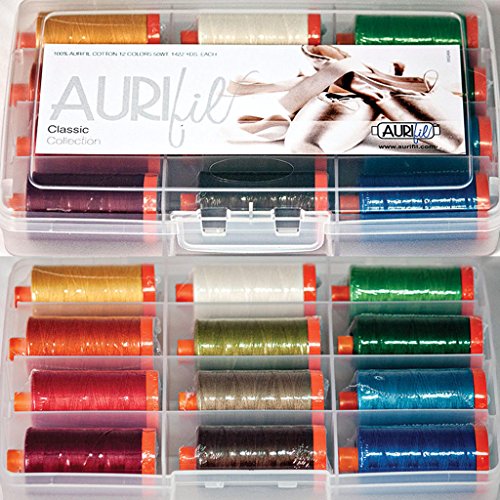
Aurifil Classic Collection 50wt Thread Set
Under $250A wider Aurifil collection for matching thread to fabric.
Check price
Janome HD9 Professional High-Speed Straight Stitch Machine
Under $2,500A precise straight-stitch machine that makes the most of fine piecing and quilting threads.
Check pricePrices change often, so confirm on Amazon. As an Amazon Associate we earn from qualifying purchases.
Frequently asked questions
What is 50 wt thread used for?
50 wt thread is used for piecing with flat seams, garment sewing, machine applique, subtle quilting, bobbin thread. It is described as fine. It sits in the middle of the range, strong enough for everyday seams and fine enough to stay out of the way. The go-to piecing weight for many quilters.
What needle should I use with 50 wt thread?
Start with a 80/12 Microtex, Sharp, Universal, or Denim (Aurifil 50 wt); 90/14 Topstitch (Superior So Fine! 50) needle for 50 wt thread, which is an 80/12 needle in Schmetz sizing. The needle eye must be large enough for the thread to pass without shredding, so heavier threads need bigger needles and topstitch needles with longer eyes. If the thread frays or breaks, move up one needle size before adjusting tension.
Is 50 wt thread thicker than 60 wt?
Yes. Thread weight is an inverse measure, so the lower number is the thicker thread. 50 wt is heavier than 60 wt, which is fine. Thread weight (wt) is an inverse measure: the higher the number, the finer the thread.
Can I use 50 wt thread in the bobbin?
Yes, 50 wt works in the bobbin on most machines. Many quilters match the bobbin weight to the top thread for balanced tension, while others choose a finer bobbin thread so more fits on the bobbin. Test on a scrap sandwich and adjust tension until neither thread shows on the wrong side.
Why does my 50 wt thread keep breaking or shredding?
Nine times out of ten the needle is wrong or worn. Fit an 80/12 needle or one size larger so the eye clears the thread, and change the needle every 6 to 8 hours of sewing. Then check that the machine is threaded with the presser foot up, slow down, and only after that lower the top tension a notch. Cleaning lint from the bobbin case fixes a surprising share of the rest, as the sewing machine maintenance guide explains.
Is 50 wt the same as all-purpose thread?
Broadly yes. All-purpose thread on a standard spool is usually 40 to 50 wt polyester, so it sits in the same band as 50 wt. The difference is fiber and finish: quilters often prefer long-staple cotton at this weight because it sheds less lint and presses flatter.
What brands make 50 wt thread?
Examples of 50 wt thread include Aurifil Mako 50 wt, Superior So Fine! 50, WonderFil Konfetti 50 wt. Brands label weight differently: some use the weight system and others use cotton count, such as 50/2 on Aurifil spools. Aurifil labels cotton with the Ne (Number English) cotton count: the number of 840 yd hanks that weigh 1 lb.
Sources
- Superior Threads thread education: weight, cotton count and needle pairing
- Schmetz needle and thread chart (needle size by thread weight)
- Thread makers' spool labels and specifications: Aurifil Mako 50 wt, Superior So Fine! 50, WonderFil Konfetti 50 wt
How we research: we compare manufacturer specifications, owner manuals, published standards and recurring themes in verified owner reviews. We do not test products in person, and this is researched guidance, not professional advice. Follow your machine manual and pattern, and take care with rotary cutters, hot irons and needles. As an Amazon Associate we earn from qualifying purchases.